Unknown's avatar

SounsAfrica – Hands-on Makes a Difference


sounsremedialSA13

Thank you, Rotary Districts 6900 and  9400, and The Rotary Foundation! Another confirming detail from recipients of your gift of literacy through the Souns program. The following communication says this project is making a difference!

Working with remedial students using the Souns program:

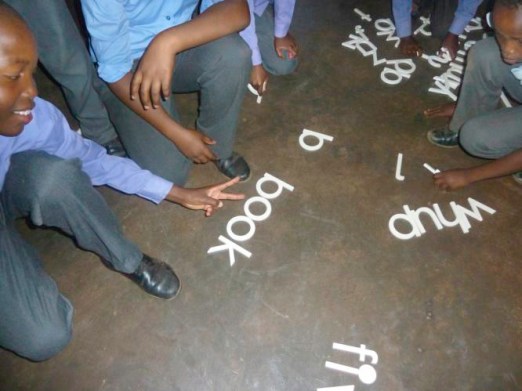
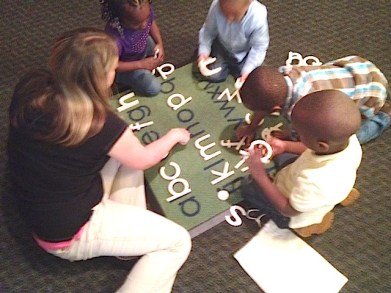
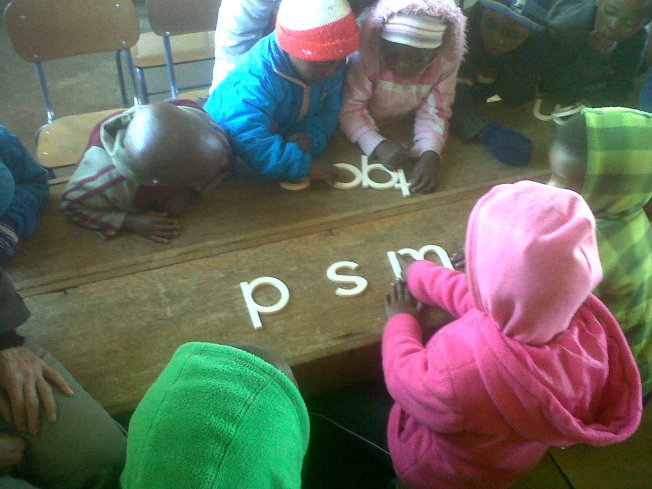
The students got through the program already today after starting about January 15th, probably because they are older, but they did not know all the letter sounds before now. They just loved manipulating the Souns and making words. I think they could have played with them for weeks. I will probably let them work with the Souns letters off and on all year. I just love the picture with the kid who figured out how to write “scool.” 

sounsremedialsa13-2


Unknown's avatar

Data Shows Progress for Head Start Students

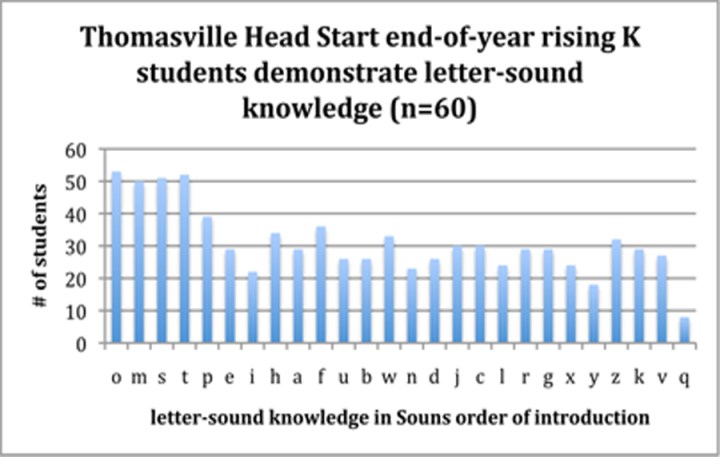
Promising data comes out of a Head Start Center piloting the Souns program. The center is part of the Southwest Georgia Community Action Council (SWGACAC) Head Start Program overseeing 18 counties.

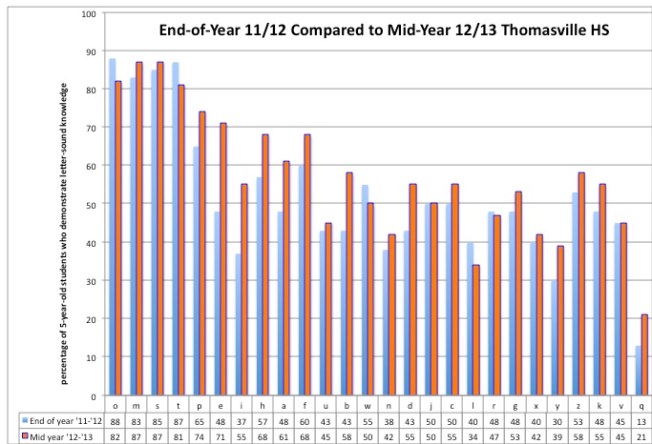
This is the second year the Lester Street center has implemented Souns – thanks to the Rotary Club of Thomasville. Recently, the rising kindergarten students had a mid-year (January 2013) evaluation of letter-sound knowledge learned through the Souns program. The following graph compares end-of-year (2011/12 – N=60) results with the mid-year (2012/13 – N=38) results showing percentages of students demonstrating letter-sound knowledge in SounsⓇ sequence. The graph confirms a story of learning for everyone .

 thomasvillecomparative12-13

It will be quite interesting to visit Lester Street again in May to get end-of-year data for 2012/13. The teachers and administration have been so loyal to this program. It is clear everyone is more comfortable with Souns this year. Good practice is building. As familiarity with this deceptively simple program develops, the results will compound until children are able to sound out phonetic words prior to entering kindergarden. That is a very attainable goal for typically developing children using Souns as designed.

It is also helpful to see certain similarities in the two evaluations, especially which letter-sound associations children find more difficult to learn.

Unknown's avatar

“Oo! Oo! I love, love, love letters!”

sounscsjan13-2

Words of a 4-Year-Old From-the-Field in Colorado Springs

A gift from Rotarian Robby Dale Nelson of Rampart Range Rotary Club of Colorado Springs provided Souns literacy materials to the two GET SET classrooms of preschool children from economically challenged communities in the city of Colorado Springs, CO, USA. Teachers and community volunteers were trained in the implementation of the Souns program – a 2.5 hour session one morning in August. The materials were received for the start of school mid-September 2012.

Included are reflections and images  from a follow-up visit and training – again, 2.5 hours – in January 2013. There will be a third visit at the conclusion of the year. The results of the Souns program never cease to astound us. Faces glow as teachers share their successes, confirming their children are really learning to read.  The children take to Souns like air to their lungs, filling up with an understanding of the endless bits of print in the world around them, inaccessible at their age without letter-sound associations. Then the fun begins.

“Learning is more effective when it is an active rather than a passive process” -Euripides (Thank you, Mo!)                                          Mo Weinhardt ‏@ArtofParenthood

sounscsjan13group

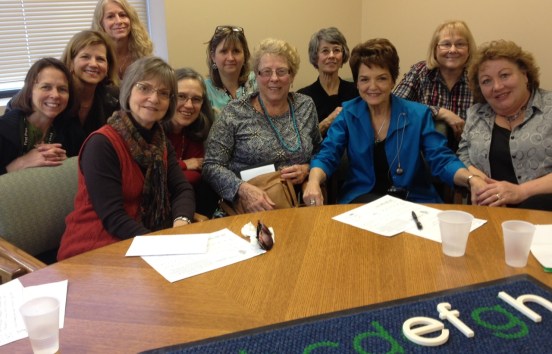
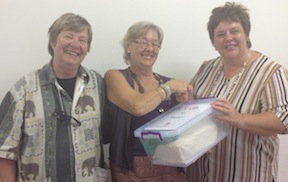
RD 5470 Governor Carla and Rotarian Robby Dale are pictured with teachers and volunteers.

The following are reflections from the teachers and assistant.

From the assistant: Souns is such an amazing tool to put in the hands of these precious  4 year olds. Their intellect grows exponentially as their confidence and joy blossom into life with learning. The light that beams from their eager eyes is an incredible gift to behold. This reading and learning program [Souns] starts them off on a fulfilling life of learning, ready to make their own history.

Teacher one: The children have grasped letter-sounds much more quickly this year through the Souns program. Their retention of the letter-sound associations is better, too. They love learning their sounds, never wanting to miss an opportunity to work with the beautiful pleasing letters of Souns. Being able to hold each letter somehow makes it “theirs” – they have an ownership, a relationship with the letters.

Teacher two: The children came back after Christmas excited to be back at school. We were expecting the kids to have lost some of the knowledge of letter sounds. But we were surprised to see how much the children remembered and how quickly they were learning new sounds. Now we have several children excited about putting letters together to build words. It is so encouraging to see the children’s progress in learning to read. When working in small groups, the kids not included exclaim, “Do I get to do it?” 

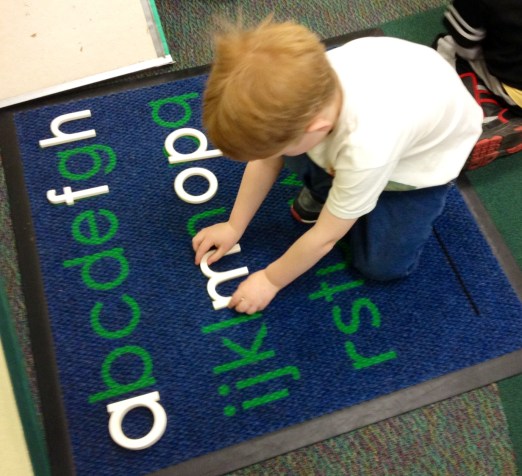
See what a 4-year-old can do if he learns letter-sounds through play and exploration.                                                                                Thank you, Rotary!


Unknown's avatar

Final Results – A Year Later In SA

sounsworksknysna1

The SOUNS Literacy Programme was first introduced (through a grant from  Rotary International) into preschool classes in 2010, and a relatively small number of preschool learners in the Knysna area were taught according to the correct SOUNS methodology.

Since January 2012, thanks to a further grant from DG Murray Trust, all classes at 22 Knysna Education Trust preschools had the benefit of receiving SOUNS kits, teachers in the field were trained to present the programme in Afrikaans, Xhosa and English as required. Volunteers were trained to monitor progress in the preschools and the learners’ progress was tracked by teachers and volunteers who reported back to KET regularly. Staff at KET was able to present the programme in both Afrikaans and Xhosa, which are the usual community languages of the Western Cape.

EVIDENCE FROM GRADE 1 TEACHERS:

During the month of June 2012 [mid-school year in SA], Grade 1 teachers indicated that learners who had been on the SOUNS programme the previous year were performing well in Grade 1 literacy, with performance indicators well above national and provincial averages. Teachers reported the following levels for learners who had previously learnt SOUNS at preschools: 53% good – excellent, 30% average – satisfactory, and 16% weak.

For the entire evaluation of preschools, please click here:

Nov12- NEW SOUNS LITERACY SURVEY November 2012 (2) (then click again)

Unknown's avatar

Alongside Their Children

sounsworkspretoria2
Below is a Peace Corps volunteer’s from-the-field  report about a literacy effort she initiated.  PCV’s are such a force for good in humanity. They serve in ways that change lives in lasting ways in their assigned communities. What awesome work they do! This PCV is currently structuring a plan to sustain this literacy program past her term of service.

Her words:

           A Family Outreach Program began in three informal settlements. Tribal leaders nominated residents to serve as “Community Development Coaches.” These Coaches were trained in early childhood development, play, nutrition, and gardening. Each Coach works with ten families for two years at a time, conducting weekly home visits and teaching both parents and children together. The program targets children ages 1-5 years whose caregivers do not have a source of income (excepting social grants). In 2011, toys and books were donated to each of the families in the program. The arrival of the books prompted the Coaches to request training in literacy. In November 2012, nine Coaches were trained on the SOUNS method and began to implement SOUNS with 110 children in the program.

            Most of the children were immediately delighted with the SOUNS symbols. They readily mimicked the Coaches and eagerly handled the O-M-S-T as each sound was presented. Even the children’s caregivers were excited to participate. Many of these caregivers are illiterate, and SOUNS provides an opportunity for them to learn basic literacy skills alongside their children. At one home visit, the grandmother in charge of four young girls sat to the side, pronouncing each sound carefully and showing her granddaughters how to feel the symbol. X (pronounced “sh” in Tsonga) is already a favorite among the children who giggle every time they shush their Coach. By using the SOUNS method, the Coaches expect to prepare these children to enter Grade R on par with their peers who have attended crèche. 

Unknown's avatar

Interim Souns Report From Knysna, SA

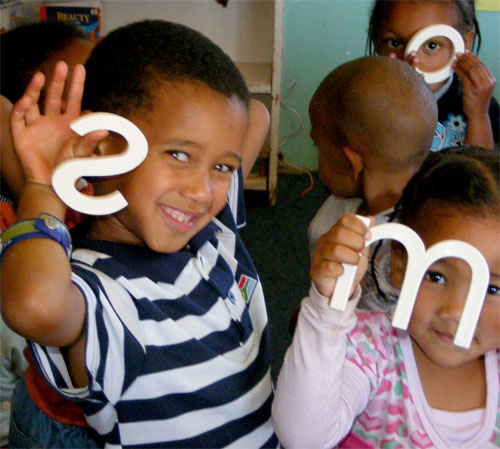
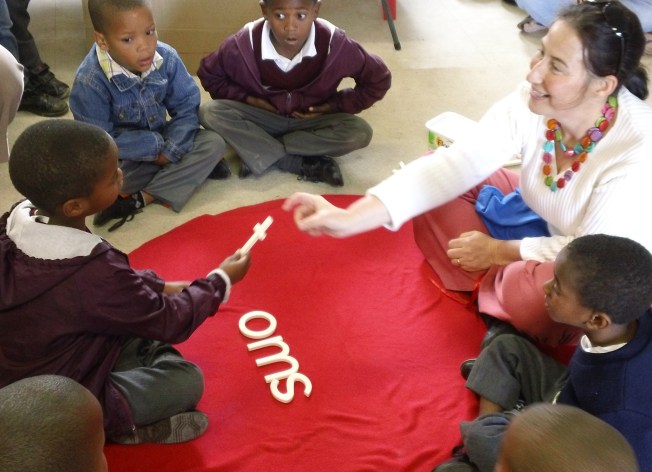
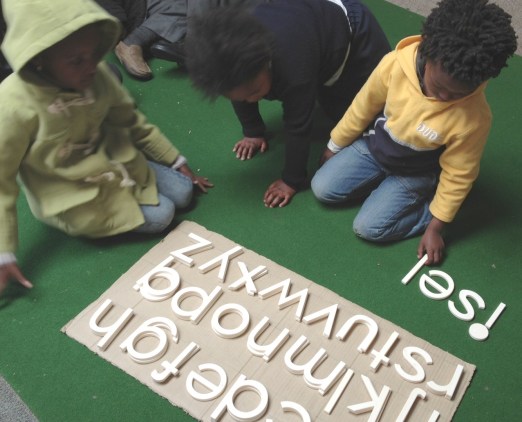
5 year olds building the word isele (frog) by listening to sounds.

In 2010 the first SOUNS kits (2 alphabets of lower case letters and training booklet written in English) were piloted at selected preschools affiliated to the Knysna Education Trust, supported by a matching grant from Rotary Districts 9350 (SA) and 6900 (USA).

In 2011 all 22 of the KET preschools received a SOUNS kit to share among its classes.  At this stage material in the local languages was prepared so that the teachers understood the methodology of the programme correctly, and a local DVD was produced to be used in the training. It was soon realised that there was a need for a Xhosa-speaking person in the field to make sure that the teachers were following the instructions and monitoring their learners’ progress correctly.  A person was appointed by KET to work in the field on all aspects of preschool education, which also included SOUNS. Towards the end of 2011, a generous grant was accessed from the DG Murray Trust, which enabled every teacher at the KET preschools to receive her own SOUNS kit for her own class.  The kits were made up with everything required to present SOUNS successfully, including a polar fleece mat for 8 children to sit around on the floor, and a file containing information about SOUNS in Xhosa and Afrikaans.

In 2012, the kits were distributed to every preschool teacher in KET preschools, and they were trained in the methodology of the programme.

At the same time, volunteers were brought in to monitor progress of learners in every class.  21 volunteers offered their services and one volunteer agreed to monitor 2 preschools that bordered each other.   17 of the original volunteers are still busy with the SOUNS programme (3 have accepted permanent employment, and 1 has gone to England for several months).  The volunteers monitor the progress of the learners (the teachers do the teaching), and guide and support the teachers in the field.  Every teacher reports that she enjoys the regular visits of the volunteer concerned, and the volunteers report that they feel welcome in the preschools. The teachers are proud to show off their learners’ progress to the volunteers when they come.

1.     EVIDENCE FROM Grade 1 TEACHERS:

A list of learners was compiled to try to track learners who had had SOUNS in 2010 and 2011 in KET preschools and Grade R classes, now in Grade 1, in 5 local township primary schools.  172 learners were identified during June 2012 and the following information was supplied by Grade 1 teachers with regard to their performance in literacy after 6 months in primary school:

91 (53%) good – excellent       52 (30%) average – satisfactory      29 (17%) weak                                     

2.     KET PRESCHOOLS SURVEY:

21 of the 22 KET preschools and 17 volunteers replied, in varying amounts of detail. One preschool is being rebuilt, and the teacher did not get her information to me because she was busy moving her preschool into temporary accommodation.  Information from both volunteers and teachers has usually been consistent.

3.  FACTORS THAT MUST BE CONSIDERED, AS GROUPS ARE NOT HOMOGENOUS:

3.1            Some classes consist of mixed ages and languages.  It is recommended that children learn SOUNS in their mother-tongue, in a group who speak the same language. However, there are foreigners from other parts of Africa in some of the classes.  One Child Welfare preschool has an Afrikaans-speaking teacher with Xhosa learners, and she is trying to teach them SOUNS in English!  None of them will go to an English primary school.  We have Xhosa learners in Sedgefield, with a Xhosa teacher, but the primary school there is only Afrikaans-medium at the moment. These are practical problems, and they will interfere with the children’s future educational development.

3.2            Most teachers report that absenteeism among their learners is a challenge.

3.3            Learners in township preschools come and go, joining and leaving classes throughout the year.

3.4            Individual teachers have had personal traumatic experiences, and this causes ups and downs in teaching. It is expected that the same has happened to some of the learners.

3.5            Some preschool facilities are extremely overcrowded.

4.   LEARNING AND TEACHING:

4.1            By August 2012 many of the older learners (Grade R) knew all the SOUNS of the alphabet, and could decode and encode many 4, 5 and 6-letter phonetic words.  The teachers have found “phonetic” a challenge, as the words they give their learners to build and decipher must be able to be sounded out with the individual sounds that the children have learnt, (e.g. ses, and sestig are phonetic, but not sestien).  Suitable word lists in Xhosa, Afrikaans and English have been compiled, and teachers still need guidance in selecting phonetic words for the learners to work with.

4.2            Teachers in the preschools have become more confident and capable as they have become more familiar with the programme, and the learners have more scope for experimentation.  Teachers have reported that they enjoy teaching SOUNS, the children look forward to it (“It is like play when we do SOUNS!”), and they are all proud of their progress.  Most parents are impressed, as are the volunteers, who speak highly of the programme (“This is a wonderful system, and I was amazed at the progress we saw.”)   In my own visits I have been impressed with the teachers’ attitudes, they have been patient, kind, calm and positive towards their learners, and have handled them all in a most loving way.

4.3            The languages that are used in KET preschools are mostly Afrikaans and Xhosa.  In Afrikaans, one can start with 2 and 3-letter words, e.g. om, and os, but the shortest Xhosa words are usually 4-letters, so the learners have to listen more attentively when forming their first words. In Xhosa there are also repetitive syllables, like mama, tata, sisi, which enable the learners to experience patterns in words.


5. GRADE R :

8 Xhosa classes, 9 Afrikaans classes, 3 Mixed Classes, 1 Has changed from Xhosa to English, 1 did not reply.

Time on SOUNS Letter Knowledge Building Words Reading Words
18 and 23 months      All 26                  5-6 letters 5-6 letters
16 months     All 26                                           5 letters, names  
13 months 13  4 letters   3 letters
13 months                 12  3-4 letters  
12 months                  All 26                                           4-6 letters  
11 months                  All 26                                          3 letters  
11 months                                                       15-all 26 3 letters  
9 months                     14 3 letters  
9 months                    10 3-4 letters  
8 months All 26                                           3 letters, names  
7 months                    24-all 26                                     4 letters, names  
7 months 20 3-4 letters  
7 months                    15   3-4 letters, names  
7 months                    13 6 letters, names  
7 months                    13 5 letters, names  
6 months 12-all 26  
5 months 12  

Some teachers have reported that their Grade R learners are also enjoying writing words (on paper, board, sand etc.) at this stage.

6.  4 and 5 Year old Classes :  5 Xhosa Classes, 8 Afrikaans classes , 1 did not reply.

Time on SOUNS Letter Knowledge Building Words Reading Words
14 Months 13 – 26 4 Letters
7 Months 26 4-5 Letters
7 Months 18 3 letters
7 Months 15
7 Months 10 3 letters
7 Months 10
7 Months 9 – 13 3 Letters
7 Months 4-13
7 Months 9 3 Letters
 Months 9 3 letters
7 Months 6
7 Months 7
5 Months 9

A teacher in this age range has reported that her learners recognise the word STOP. Another teacher sings a SOUNS song to her class.

7.  3-4 Year Old classes : 3 Xhosa Classes, 4 Afrikaans Classes, 1 mixed class.

Time on SOUNS Letter Knowledge Building Words Reading Words
7 Months 14 6 letters
7 Months 13
7 Months 12 – 26 3 letters
7 Months 10
7 Months 8 – 26 3 letters
7 Months 6
7 Months 6
7 Months 4-10

One teacher reports that her learners have started identifying letters that they have learnt at the beginnings of their names and other words.

8. Under 3’s : 6 Xhosa Classes, 4 Afrikaans Classes.

Time on SOUNS Letter Knowledge Building Words Reading Words
7 Months 13 – 26  
7 Months 12    
7 Months 10    
7 Months 7-14    
7 Months 6    
7 Months 4    
7 Months 4  
7 Months 4    
7 Months 3-11    
7 Months Babies Crawl around and handle them    

As was reported in June 2012, there is clearly a wide range of performance in all age groups.  This will depend on time spent on the programme, as well as many other factors within each preschool, teacher and child.  All ages have shown progress, and more teachers have reported starting word-building in the past 2 months.

CLOSING COMMENTS:  The closing comments from both volunteers and teachers who are participating in the programme speak for themselves.  The vast majority are VERY enthusiastic!

VOLUNTEERS: “This is a great system, and I am so impressed that children as young as 3 years are able to identify sounds confidently.  The teachers have impressed me.”

“The children and teachers enjoy ‘outside’ person taking an interest in their (pre)school. Consequently the visits have been most rewarding as one feels appreciated and the teachers don’t regard you as a threat.”

“The teachers are well organised and display a genuine care for their work and want the children to succeed with their project”.

“The teacher is very patient and encourages her children….She is structured and systematic with the children who are very small, and the children want to please her.”

“Holidays make a big gap in the learning. The teacher is enthusiastic and the children respond well.  This group has really improved this term.”

“The teacher applies the programme effectively and incorporates it in her daily teaching….She has wonderful results and I was amazed at the progress I saw every time I went back.  This programme is fantastic and it works!”

“The teacher works at the level of the children.  She is patient and prompts them when they hesitate.  She had a chart and asked them to place the SOUNS on the letters which were arranged in an alphabet….She makes everyone clap when they get something correct and prompts those who falter.  Very gentle but assertive.”

“Most of the group are quick, confident and ready to move on.  Their enjoyment is evident – they are a great credit to the teacher”.

TEACHERS:

Most of them say they enjoy teaching SOUNS.  The children “love” learning SOUNS and are “excited” about the programme. “They are curious about SOUNS”. “That is the pleasure, even to feel the SOUNS” “Kinders kan nie wag wanneer ons met die SOUNS begin nie”.

“They are very glad when they see the SOUNS, they say we are now ready to do our work”.

“The SOUNS are very important, especially for Grade R because SOUNS help them develop their thinking and language skills.”

“My children can read and write.  Their progress is good and has a big effect on children’s lives.”

“Four of my children have a hearing problem…” (Discovered through working with SOUNS).

“Parents appreciate the progress because their children can learn a few words.  They answer if you ask…” “They speak more clearly”. “Parents hear (listen?) when children talk or tell a story”.

One of the preschool teachers who also has an aftercare facility for older children, reports that those children’s spelling has improved as a result of them using SOUNS at her preschool.

“The programme makes things easy to manage…and developing children’s skills, knowing names, counting and numbers”.

“Children remember easily”. They “learn well and listen.”

“Children call out SOUNS at home”.

“Parents are proud.”  “SOUNS make children brilliant, not even at preschool, but at primary school also”.

When I teach them, they are free and listening”.  The little ones are “just playing with them and eat them.”

“The children go to the alphabet chart and say the SOUNS that they know. They will be the best generation.”

“Children ask for books and paper at home.”  “They respond to alphabets, and words on TV and magazines”.  “Children point to letters in shops and street names”.

SOUNS is a “fun way to learn”.  The children play on their own with SOUNS and become “clever”   each day.

A 3-year-old shows her Mom the S of Siyafunda on the way to preschool every day.

“Ouers is beindruk met SOUNS want dit gee ‘n hupstoot met die alfabet.”

“Die program help my baie met kinders wat skaam is.  Dit gee my ‘n kans om ‘n sterker band to bou en terselfde tyd leerders se developmental stage vas te stel.”

Two teachers do not know what their parents think – they have had no contact on this level.

Some teachers would like more training, and this need will be addressed soon.

One of our preschool principals has this to say: “Your motivation and inspiration are helping us here…..to prepare leaders and readers for the future of the world.”

KNYSNA EDUCATION TRUST 2012

(Watch for the final report in November.)

Unknown's avatar

One Leap For Literacy

What can eight months do for literacy in a Head Start Center? Combine a furiously determined Center Director and a local Rotary Club and children will read! The Rotary Club of Thomasville, GA, and their local Head Start Center have joined in the work of literacy.

Nine classrooms – including three Early Start classrooms – began training in the Souns program in October of 2011. Several follow-up visits occurred between October and May to observe how the work was going. During the last week of school, each of the students age-appropriate to be graduating into local kindergartens were evaluated to see progress made. The results are below. It is not surprising that they reflected a direct link between those who followed the program and those who did not. The teacher is the magic that makes any program work.

This center has an abundance of remarkable teachers working with their children. After this year’s success, we expect all the teachers will see the value of this simple program for their children. It is understandably difficult to accept a program that is counterintuitive. We have been so steeped in teaching letter-names first, that the idea of teaching letter-sounds first causes resistance. Thanks to those teachers who stepped outside the box in Thomasville, children will read. The results are quite clear. Consider the data at this year’s end, when those little four year olds who are going into their second year with this program are evaluated.

We smile with tears in our eyes at what is happening in southwest Georgia. Determined people working together can make a difference. Thank you, Rotary!

Every – Yes, every – child will read.

Unknown's avatar

“Babies Can’t Wait / Souns” Update 2013


golfclassic13-1

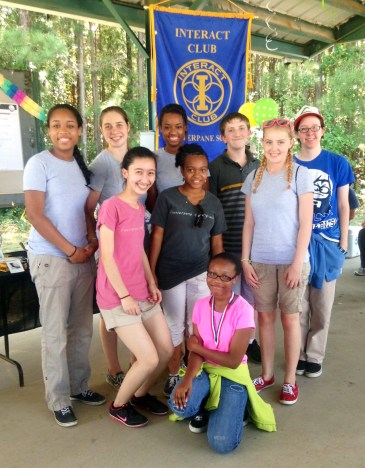
Counterpane Interact Club sponsored by Rotary Club of Peachtree City, GA (D6900) supporting Babies-Can’t Wait 2013!

If your child is enrolled in Georgia’s Babies Can’t Wait program in Fayette or Coweta Counties, he or she is eligible to receive, free-of-charge, certain materials from the Souns for Literacy program. This is being provided through the generous giving of those who support the Counterpane Golf Classic. Counterpane is grateful to our community and for our ability to give to children beyond our walls. Together, we have helped hundreds of Babies Can’t Wait families build literacy through Souns.

Recent national research in early learning is pointing to the need to expose children under three to the printed symbol, thus combatting our rising problems with childhood literacy in this country. The research also confirms that the method of teaching reading to children that shows significant success is one that exposes children to learning the sounds of the alphabet.  The Souns method works by caregivers giving their child lower-case letter shapes (4 inch, hard, nylon symbols) and using the most common letter sounds instead of the letter names to describe them to the child. The method uses natural learning through play and parent interaction. For a full description and photos please
read the Souns White Paper.

Babies Can’t Wait is committed to helping children achieve their full potential through supporting a family’s capacity to give their children all the opportunities available to them. Providers in the Babies Can’t Wait program in Fayette County are trained in implementing the Souns method of literacy and can guide caregivers through the process while they are enrolled in Babies Can’t Wait. Once the child exits the Babies Can’t Wait program they can still continue to work with Souns materials and receive support through monthly visits to the Peachtree City Public Library, or attending Counterpane School’s free Early Literacy Workshops The only thing requested of the caregivers is open communication about their needs as they implement the program with their child. We realize importance of individualization for families and children.

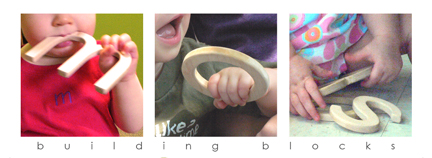
The image above comes from our archives and reflects when each letter was crafted in wood. We thank United Way of Metropolitan Atlanta for funding molds for Souns. While wood is beautiful, it breaks and is not as easily cleaned as the nylon. Counterpane seeks support for this outreach program. Consider playing in our annual Golf Classic, designed specifically for our literacy outreach locally.

Please consider joining in our extended community to help this cause.

Unknown's avatar

You Will Be Surprised!

Where are we now with the collaboration of hearts, minds, talents, and resources intent upon children reading in South Africa? There is power in joined forces: Rotary Districts 6900 and 9400, Rotary Club of Pretoria East in South Africa, Rotary Club of Peachtree City , GA, USA., and the Peace Corps in South Africa. The Rotary Foundation funded a Global Grant which is impacting thousands of children from rural villages and urban townships across provinces in South Africa. Miracles do happen. Children will read! Thank you, Rotary! Thank you, Peace Corps!

A comment  from Robin Jones, the Rotarian heading this RD9400 and RD6900  project from Rotary Club of Pretoria East, South Africa –  The feed back from the existing Peace Corps volunteers (PCV’s) is slow but what I have received is amazing. You will be surprised at the numbers of kids we are reaching.

One PCVToday is our first day back to school after winter break. The kids I worked with today were all so excited I was back to teach them! Right before break I had tested each class on which sounds they have mastered. I assumed most of the kids would forget some of the sounds over break but surprisingly that wasn’t the case. All the kids had done extremely well in both remembering the previous sounds and with the introduction of new ones today. A few weeks before break we had started on constructing words which I plan to continue next week since our knowledge is expanding.

Another PCVI don’t know how much you have heard about the excitement level with souns and Peace Corps, but to say it is high would be an understatement. Many folks are reaching out to South Africa Rotary, Rotary back home, and planning together. It really is a great time. One of those awesome folks works with a large NGO. They are spread throughout the country and work with 56 creches. She has submitted a proposal to do trainings for each of these cretches. Pretty exciting to think about the impact this can have on early literacy.

Yet another PCV I have been using SOUNS  for about 2 months in the Creche. I spend 4 days two hours each day teaching small groups (6-8) of toddlers 3-6 years old. It is a wonderful tool for teaching phonics….And the lower case alphabet is definitely the way to go! The plastic letters are indestructible: they have been chewed, dropped, sucked, thrown, kicked, ‘crayoned’, pulled…all without the slightest damage. I really love this program. It sets a good pace for kids learning…and the kids absolutely love these letters and sounds. I am hoping to see a difference in the Grade R at the Creche who will be entering Grade 1 at the Primary School.

And yet another PCVI was wondering, could we get other Rotary clubs to sponsor sets? For instance, my mom is in Rotary in North Carolina, does US Rotary have connections to other groups that could help us out?

“Can you help us out?”  is a call from the field for assistance that is so small in terms of dollars. You can help a Peace Corps volunteer help a classroom of children in his or her village. We have some materials funded now, with additional funding requested; but the numbers of classrooms are beyond that scope. One Rotary Club supporting One Classroom  will make the world shake with potential for these kids.

Peace Corps volunteers are passionate, committed  resources for their villages. They are teaching the children and the teachers so this work is sustainable. Rotary Districts, Rotary clubs, Rotarians or benevolent minded readers, consider what $200 will do, as that is all it takes for a classroom (no expendables, so imagine the impact over years).  Souns is a global Rotary literacy option (see Rotarian, August 2011) from  Counterpane, a 501-(c)- 3 non-profit educational organization. Your gift supports classroom materials only. All Souns training for Rotary projects is in-kind giving by Rotarians. Email everychildwillread@gmail.com or click below and support a classroom. Thanking you forward! Every child wants to read!          Please Donate!

  
Unknown's avatar

It Began With Rotary! Now Look!

This literacy effort began with a Rotary Matching Grant between RD6900 and RD9350. The lead Rotary clubs were RC Peachtree City (USA) and RC Sea Point (South Africa).  Now look! SounsAfrica has grown legs of its own!! https://sounstalk.org/wp-content/uploads/2012/08/souns-survey-june-2012.pdf

The following is an email with a powerful attachment from Knysna Education Trust in South Africa. KET is the source for Souns in South Africa for all activities outside of Rotary projects. They are really making a difference for literacy.

I thought you may be interested in the survey that I collated in June this year.  We are very pleased with the results that it shows.  I need to do another one for DG Murray Trust mid-September.  It is a lot of work and effort by many stakeholders to come out with this summary, but it tells us what we want to know.

The results in the 5 primary schools in the Knysna townships, where our preschool learners move on to, are also much better this year, which is the first year that Grade 1 results are able to be measured since starting the programme in the preschools.  The school management team of the Western Cape Education Department have told me that those 5 schools are much better this year.

Lesley S.   / Knysna Education Trust