Unknown's avatar

Pave Road To Literacy With Play!

photo-192

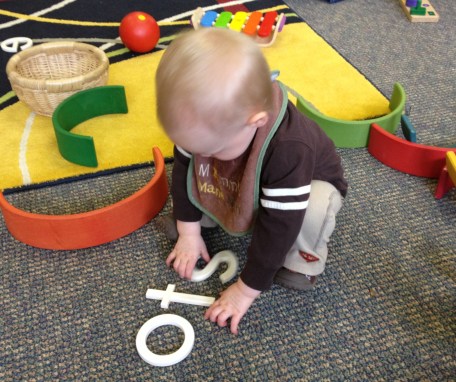
Children are our teachers! Observing how they learn teaches us how learning happens best…for any age. To build literacy, play is the way for children to learn the fundamentals of print. We can shelve all the manuals, the quick fixes, the how-to’s, and the flash cards, and follow the child to what is needed. Intentional activities that are play-based, meandering by design with the exploring mind of the child, teach us how specifically the hand defines the brain. Every detail is measured and absorbed. Be still, watch, and you will see.

A playful day with one of the families:

We had such great weather last weekend, we were able to get outside a bit. My daughter loves to play with chalk, so my husband and I drew out her souns on the driveway. We asked her (and each other) to go stand, sit, hop, whatever we could think of on her souns. We all had a blast!

We will be exploring with the child as we get our hands into some play dough. The recipe link:  http://www.mommypotamus.com/homemade-play-dough-recipe-with-natural-dyes-and-a-gluten-free-option/

One parent’s approach to this recipe:

I used the regular recipe with 1/2 cup of cranberry juice and 1/2 cup of water (and no essential oils) and it came out a very pretty pink. I keep it in an airtight container; I made it over a month ago and it’s still fine. Like I mentioned in class, my husband and I have fun with it but my daughter really won’t touch it (yet).

Till next time:photo-196

photo-192

Unknown's avatar

Building Words – A Bridge to Reading

photo-191One way or another we learn letter-sounds and apply that knowledge directly to learning to read. For the most part it works, but not without notable levels of difficulty and frustration.

One additional step can make a commanding difference in that journey to reading – building words. Consider a 1000 piece puzzle. Putting it together can be challenging for anyone. Taking the completed puzzle apart into its individual pieces to be returned to the box is quite simple by comparison.

Learning to read is like negotiating the loose puzzle pieces of our alphabet, turning a chain of sounds into a word. It is quite challenging and can lead to many failures and much guessing before success is enjoyed.

Consider the ease of taking the puzzle apart. A spoken word is like a puzzle already put together. All the sounds are there in a nice little package called a word. If the child knows letter-sound associations well, listening to the sounds and building the word – one sound at a time – (not as it is spelled) is quite confirming and informative for the child.

This step – building words – bridges code based knowledge and decoding. Children 4 and 5 years old and those challenged as readers need to develop a deep understanding of how words are built. A child who knows letter-sound associations well and who focuses on building words – one phonetic sound at a time – for several weeks to a month often transitions into reading words seamlessly.

Reading becomes the next natural step for the child who has built words by listening to sounds in words first. This has been the magic of the Montessori-minded Souns program. IT is a direct link between sound and symbol, bypassing letter formation, which is another skill altogether.

Unknown's avatar

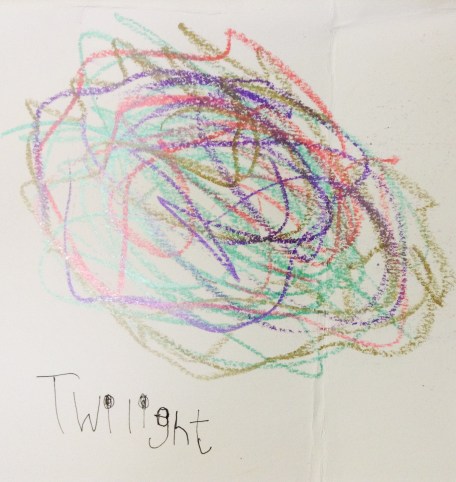
T w i l i g h t – “It IS a poem!”

photo-191

Be still, observe your child! Watch that little developing mind explore, examine, attend to every nuance in the world around it. You will be in awe at the attention to details. The extended gaze, the second glance, the questioning look, the twinkle of confirmed knowledge, the determination – all threaded by no more than a string, a crack, an ant,  a shadow, a drop of water, or a new face. Every piece of life matters in the construction of the brain. This building of a person offers no trailer, no quick view, no short cuts. There is no time when the brain is not learning (P. Wolf).  The senses are the tools that feed the brain, and they must be allowed to do their work. Gently watch your child, and he or she will show you who they are in their endless quest to become that unique bundle of talents they have unfolding within them.

The “poem” above is one mind telling us its story. Young children have SO much to say. Are we listening? Are we watching? Are we willing to be amazed?

The “poem” is from a Souns child that had just turned 5. 

Unknown's avatar

A Few Weeks Ago

Professional31-239x300

Della Palacios  @sensablelrning

A few weeks ago I met a young man who, due to life’s circumstances, started school many years after most children.  His native language is Spanish, although I would not have known as he spoke so well.His caregivers called me to see if I may be able to help him with his reading.  The computerized assessment he was given had him reading at a primary level, even though he is a freshman in high school and is several years older than most of the others in his class.

When I arrived, I introduced myself and explained that I am like a reading detective, trying to figure out what’s going on.  He was very polite so when I asked if he struggled, he answered simply, “Yes, ma’am.”  

I started like I always start with older learners, with a Sound Check using #Souns.  It was evident pretty quickly, he only knew letter names and was trying to convert them into some variation.  He did not know any sounds besides /f/ when I went through the first half.  I stopped there as I didn’t want to embarrass or frustrate him and thought carefully about what reading passage I wanted to begin with.  

I should mention here that the computerized reading assessment ‘s results said he knew his beginning sounds and blends?!

I pulled out a few phonetic phrases and he read them fine.  I looked at him and said, ”Wow.  You are smart.  You have memorized an awful lot of words to be able to read to me what you just read.”  Again, he answered, “Yes, ma’am.”

So, I told him that learning his letter sounds will help.  It will help him figure out new words he hasn’t memorized.  We began and after practicing with a number of Souns at a time, he wrote.  He wrote pot and mop and dog and cat.  Three letter words were difficult for him.  This is not at all surprising as it reveals the confusion with the short vowel sounds that get well hidden by word memorization.  I asked him if he remembered how they taught him to read when he started school since he started late.  He said the first book he every read was “Up and Down” and he recited it to me.  It sounded like a sight word book.

So we continued to work and build.  I would hear him going through the sounds in front of him while I was fumbling through the tub with the Souns symbols.  I asked if he thought it would help him and he said, “Yes, ma’am.”  He shook my hand and thanked me quite genuinely for coming before I left. 

I went to meet with him a few more times.  Both visits were the same: sound practice, word construction, and basic reading practice.  By the end of the last session, he recalled 21/26 letter sounds and three of the six digraphs.  The vowels are still the most troubling.  

The most telling thing about his reading experience thus far was the miscues that he did as I asked him to read passages for me.   We read from the McGuffey Reader.

Instead of pen, he read open.

Instead of pen,  he read pan.

Instead of run, he read ran.

Instead of song, he read sound.

Instead of pond, he read pound.

Instead of bank, he read blank.

Instead of bead, he read bread.

instead of beak, he read bake.

Instead of quite, he read quietly.

Shapes of the words were similar.  The words looked a lot like the others.  He is putting in so much mental energy into recalling each individual word, comprehension is not happening.  He is extremely bright, so once he does catch on to and start processing the language code, I suspect reading will improve.  The time and practice must take place, though.

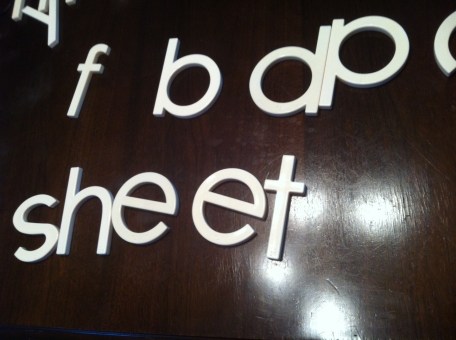
sheet


Unknown's avatar

It Is Through The Hands That We See

image-1

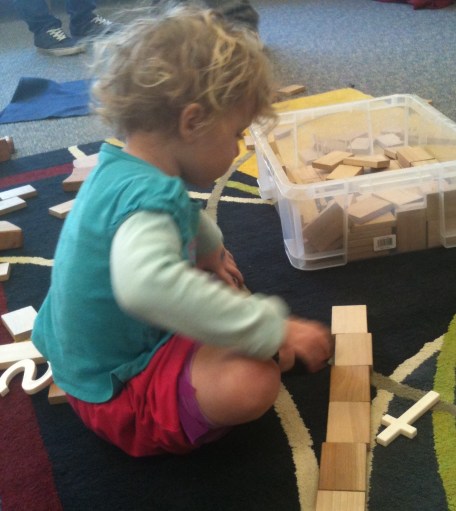
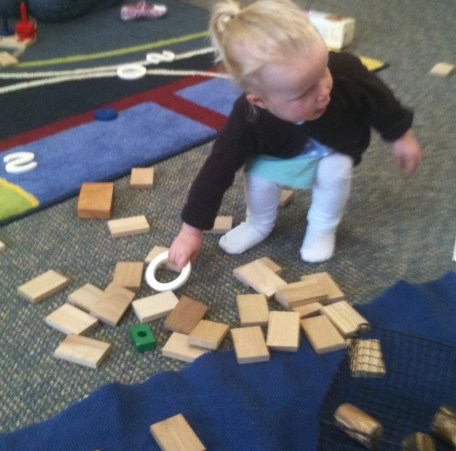
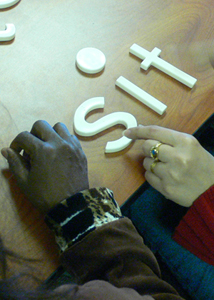
Another beautiful morning observing, discussing, and exploring “child” at Counterpane’s Free Early Literacy Workshops. Follow the hands and find learning. Information about “the hand and the brain” can be found in Lillard and Jessen’s Montessori from the Start: The Child at Home, from Birth to Age Three.

image3-8-13

Unknown's avatar

Happiness Looks Like This

smilingteacher

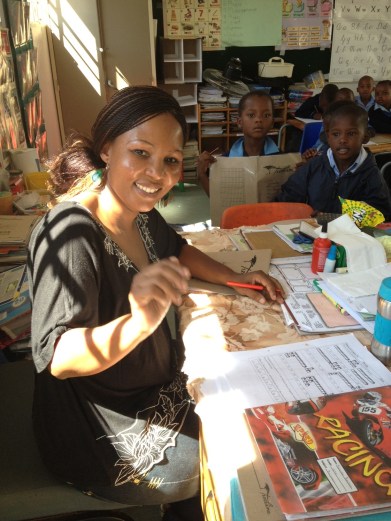
What happens to the heart when it is too filled with joy to fit in its body? It spreads like the sun all over the face. We have had over a week encountering such smiles. They arrive at the training sessions on foot and/or via crowded taxi vans – teachers and caregivers eager to learn new tools to help their children on the journey to reading.

The Rotary Global Grant 25244 was to impact 4000 children. The project is in its third year and because of community action – including the University of Pretoria and the US Peace Corps – the number of children being reached has doubled.

Rotarians from the international club typically join Rotarians from the host club at least twice each year to train new teachers or follow-up on previously trained teachers in the project. Often visits focus on classrooms. This visit focused on teacher experience with Souns. What has been happening? How is the program working? What are the difficulties? What are the great moments? Teachers are the greatest champions for their children.  I love to listen…it is magic!  For example:

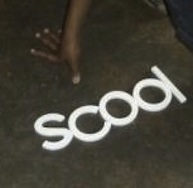
One teacher shared that she greets each child as he or she arrives at school with a Souns symbol. The learner keeps the symbol until all the children have arrived. The teacher then collects the symbols by asking for /s/ or /m/ or /p/. This takes so little time and is a daily review of the letter-sound associations being learned in the classroom at that time. That activity excited many, who want to implement it in their classrooms. There were SO many wonderful ideas shared, each relished like a gift.

There were discussions about how to meld the Souns program with the CAPS curriculum for language/literacy in South Africa. Some excellent ideas were shared and demonstrated.

Getting teachers together on a regular basis to share their questions and successes builds a repertoire of good practice with Souns. It is quite beneficial for everyone….and it is FUN!

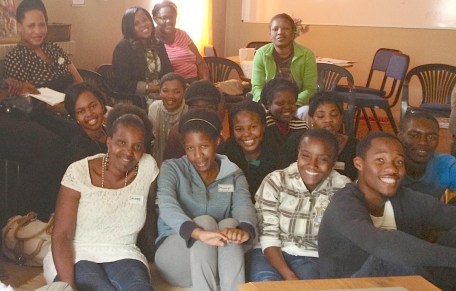
Look at the smiles!

happyteachers

Unknown's avatar

It Is Happening!

“The baby is watching them dance!” is English translation of the last sentence child reads.

One step at a time. These children had Souns in their Grade R (kindergarten) classroom last year. This mid year of Grade 1. They are well ahead of their classmates who did not have the Souns program. One child at a time – one gentle, encouraging step at a time – we will build readers in South Africa. Thank you, Rotary! You are making a difference.

Unknown's avatar

Souns With Remedial Group in SA

sounsremedialsa13-3detail

Thanks for your marvellous mail. The project is slowly developing
legs. Regards, Rotarian from Rotary Club Pretoria East

Hi [R and E],

I used SOUNS exclusively for a month in this remedial class of 10 students of 4th graders plus one 6th grader. Most of them have failed a couple of grades but I don’t know exactly what their ages are. They were suspected of being special ed students (I am a retired special ed teacher), but I think 
only one of them actually might have real processing difficulties. She still 
confuses the b, d, p, etc. and other sounds at times. Almost all of the 
students confused especially these three letter sounds at the beginning, 
with a mix of a few other letter sounds, but now do not confuse any of them.
 The word writing really took off when the diagraphs were introduced. If SOUNS was to be used for older, remedial students across Africa, my wish
 would be to have several sets of the letters available in a 
classroom, with a large table. That way they could write [words] and write to their 
heart’s content without waiting for someone else to finish using a letter.
 They could even write short sentences. I know several sets isn’t a practical 
possibility, but they love writing with those letters, and even 
watching other students write with them.

Thanks again,


[Special Ed Teacher]

handsandsitIRCsmall

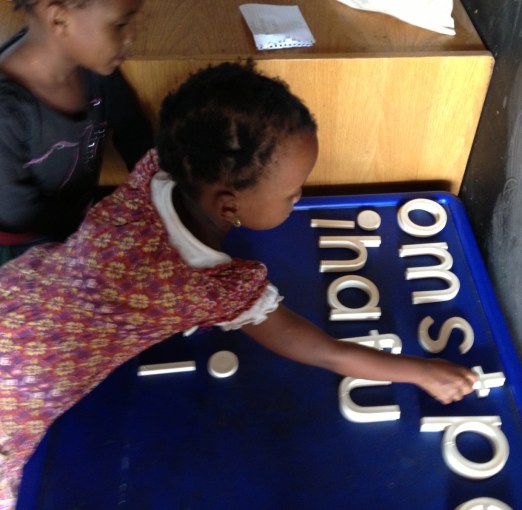
NOTE: What is described in this learning situation is exactly what our Interact Club does when working with the International Rescue Committee (IRC) in Georgia, USA: there is a large table around which the refugees sit and build words with the letters by listening to sounds in the names of things like fruit and vegetables, etc. Spelling is not the focus, letter-sound associations are key to early writing…whatever the age. They love helping one another build words, giggling at their successes. It is really beautiful to see.


Unknown's avatar

Data Shows Progress for Head Start Students

Promising data comes out of a Head Start Center piloting the Souns program. The center is part of the Southwest Georgia Community Action Council (SWGACAC) Head Start Program overseeing 18 counties.

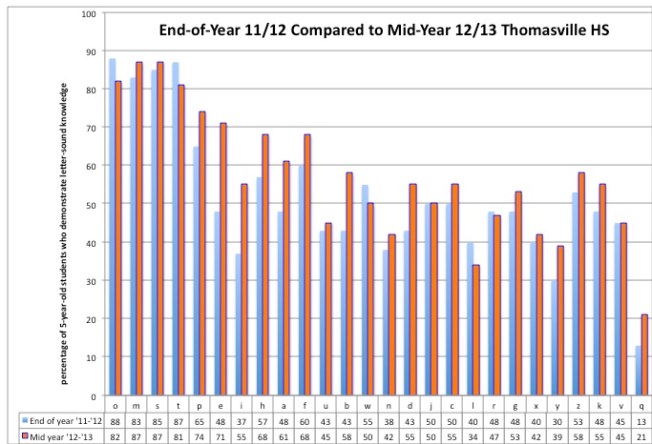
This is the second year the Lester Street center has implemented Souns – thanks to the Rotary Club of Thomasville. Recently, the rising kindergarten students had a mid-year (January 2013) evaluation of letter-sound knowledge learned through the Souns program. The following graph compares end-of-year (2011/12 – N=60) results with the mid-year (2012/13 – N=38) results showing percentages of students demonstrating letter-sound knowledge in SounsⓇ sequence. The graph confirms a story of learning for everyone .

 thomasvillecomparative12-13

It will be quite interesting to visit Lester Street again in May to get end-of-year data for 2012/13. The teachers and administration have been so loyal to this program. It is clear everyone is more comfortable with Souns this year. Good practice is building. As familiarity with this deceptively simple program develops, the results will compound until children are able to sound out phonetic words prior to entering kindergarden. That is a very attainable goal for typically developing children using Souns as designed.

It is also helpful to see certain similarities in the two evaluations, especially which letter-sound associations children find more difficult to learn.

Unknown's avatar

I M A G I N E their future!

sounselwjan13-4

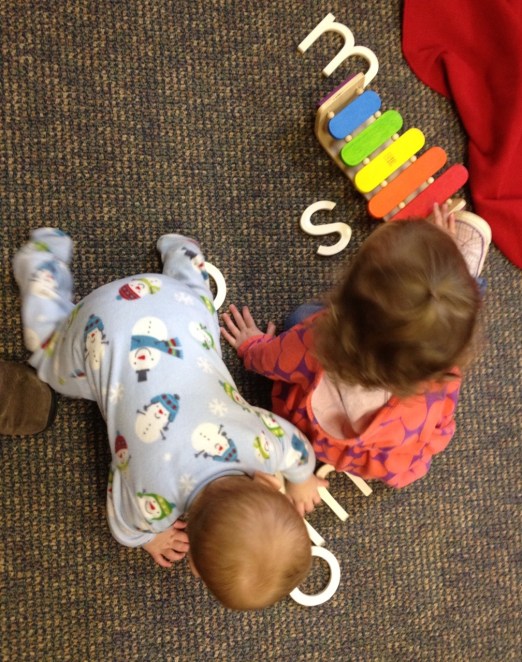
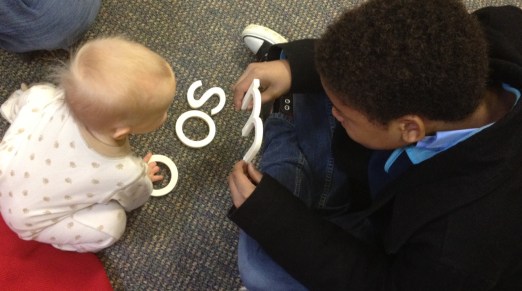
Counterpane’s Early Literacy Workshop is FREE to families in the community with infants/toddlers 0-36 months. Parents are introduced to the Souns program, play with their children, and share experiences with Souns and parenting.

This week’s meeting began at 9:30 A.M. and included a portion of a NAMTA video on the toddler community in the Montessori environment. The purpose was to discuss ways parents can support a child’s independence at home. Letting a toddler pour his own juice or remove eggs from a carton may result in a spill or a clean-up opportunity – a small price to pay for the self-worth attained by being allowed to do it him/herself. Provide the time, space, and conditions required for a little person to learn, “I can do it myself!” It may not come as words, but as a huge smile on that tiny face.

Our meetings have the added joy of Counterpane Interact Club students volunteering to engage with the little ones using Souns. We are enriching young lives and building parents of tomorrow.

The next meeting is Friday, February 8th, at 9:30 in the morning in Counterpane’s Souns room. We have a few openings, so share the idea, consider the possibilities, and email if you have interest in joining us or initiating a Souns Early Literacy Workshop, email souns@counterpane.org.

Here is a link of interest:

https://www.facebook.com/photo.php?pid=14758090&l=100a7fc5f2&id=35198465762

A must read for parents: Children the Challenge by Rudolf Dreikurs

sounselwjan13-1