Unknown's avatar

What Does Early Literacy Look Like?

sounselw2-13

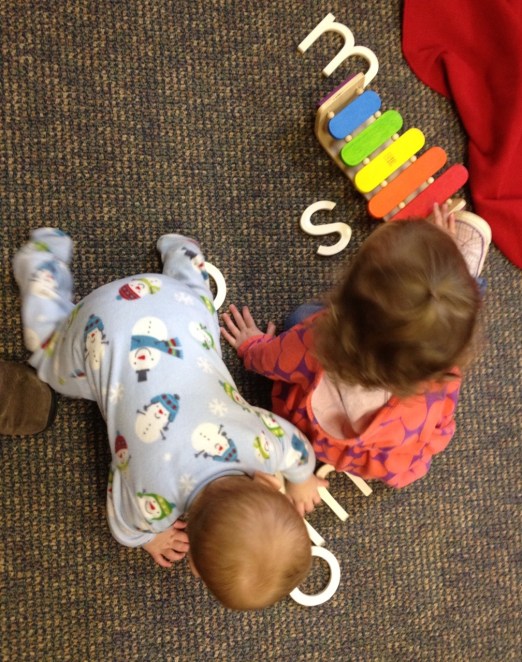
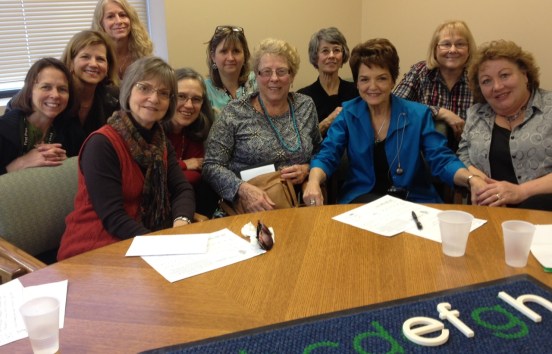
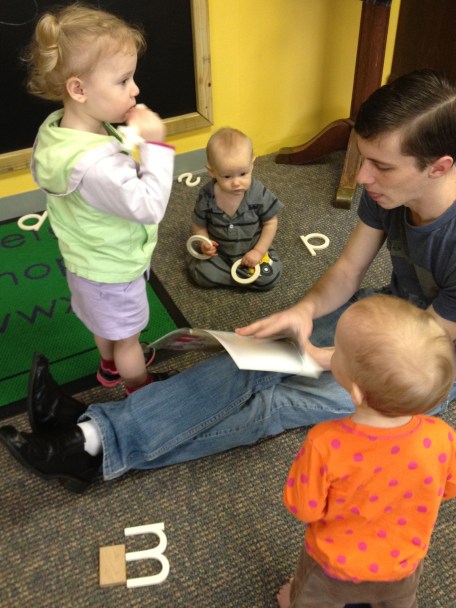
Counterpane’s Early Literacy Workshop – a community outreach for families of children 0-36 months – brings Moms, Dads, and their little ones together to share stories about Souns and parenting. During our last get-together we watched a short video encouraging parents to foster independence for their children in the home environment. Today’s harvest included one family who avoids the before dinner chaos by having their young child set the table. She loves it! Another celebrated their new “dishwasher”  –  all that is needed is a stool and happiness prevails with, “I want to do ALL the dishes!” This story was shared by the mother that, after the previous meeting, emailed the following –

Yes!! We are really enjoying the program as well… I call Nicholas my “I’ll do it” child And I spend all day trying to stop him from doing it himself. So as a parent I feel refreshed and pressure free, by giving in to this idea of, if he wants to do it, then… Let Him Do It”!!! It is almost Liberating!! Lol 

Then there was the delightful onion story. One mom was fixing dinner and her little son saw the sliced onions on the counter and targeted one piece, taking it in his hands and exclaiming, “Ahhh! This is ahh!” He has indeed learned the most common sound for the “o.”  He refused to let his mom cook the ahhh.

Souns is an amazing program and seeing these children want to match the sounds they knew with the sounds I wrote on the board and wipe specific sounds off  the board brings smiles to all of us.  Little hands placing each Souns symbol in the basket during clean-up is proof that play is the best way to teach. Reading builds vocabulary and Souns builds letter-sound associations. The desire for independence came in these little packages of humanity. The same drive for independence that wants to sweep the floor, wash a dish, crack an egg can be experienced with the symbols of our print. Just give the real tool – letter- sounds! The most magic words are, “I can do it myself!”
sounselw2-13-3


Unknown's avatar

Data Shows Progress for Head Start Students

Promising data comes out of a Head Start Center piloting the Souns program. The center is part of the Southwest Georgia Community Action Council (SWGACAC) Head Start Program overseeing 18 counties.

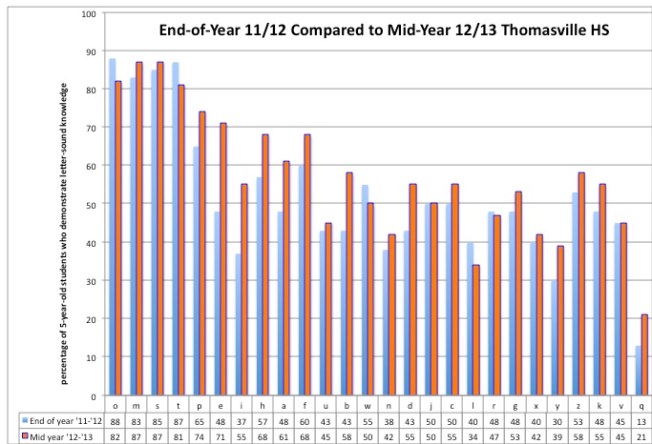
This is the second year the Lester Street center has implemented Souns – thanks to the Rotary Club of Thomasville. Recently, the rising kindergarten students had a mid-year (January 2013) evaluation of letter-sound knowledge learned through the Souns program. The following graph compares end-of-year (2011/12 – N=60) results with the mid-year (2012/13 – N=38) results showing percentages of students demonstrating letter-sound knowledge in SounsⓇ sequence. The graph confirms a story of learning for everyone .

 thomasvillecomparative12-13

It will be quite interesting to visit Lester Street again in May to get end-of-year data for 2012/13. The teachers and administration have been so loyal to this program. It is clear everyone is more comfortable with Souns this year. Good practice is building. As familiarity with this deceptively simple program develops, the results will compound until children are able to sound out phonetic words prior to entering kindergarden. That is a very attainable goal for typically developing children using Souns as designed.

It is also helpful to see certain similarities in the two evaluations, especially which letter-sound associations children find more difficult to learn.

Unknown's avatar

I M A G I N E their future!

sounselwjan13-4

Counterpane’s Early Literacy Workshop is FREE to families in the community with infants/toddlers 0-36 months. Parents are introduced to the Souns program, play with their children, and share experiences with Souns and parenting.

This week’s meeting began at 9:30 A.M. and included a portion of a NAMTA video on the toddler community in the Montessori environment. The purpose was to discuss ways parents can support a child’s independence at home. Letting a toddler pour his own juice or remove eggs from a carton may result in a spill or a clean-up opportunity – a small price to pay for the self-worth attained by being allowed to do it him/herself. Provide the time, space, and conditions required for a little person to learn, “I can do it myself!” It may not come as words, but as a huge smile on that tiny face.
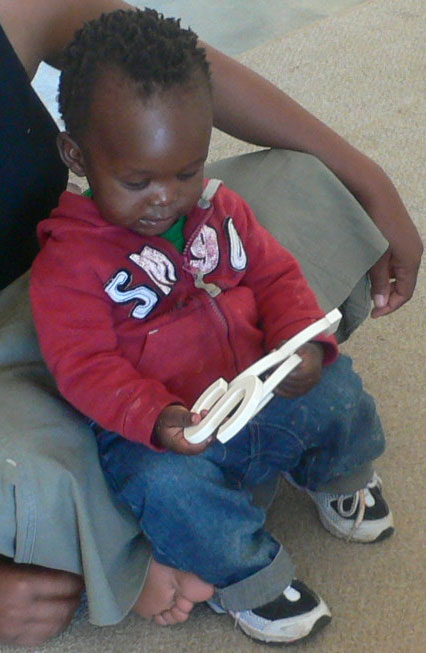
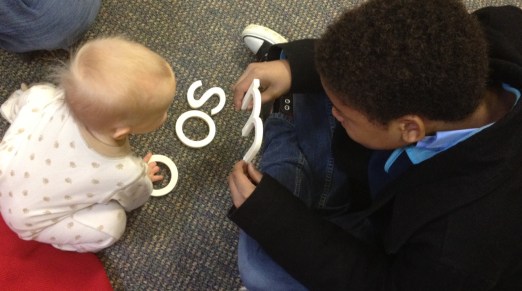
Our meetings have the added joy of Counterpane Interact Club students volunteering to engage with the little ones using Souns. We are enriching young lives and building parents of tomorrow.

The next meeting is Friday, February 8th, at 9:30 in the morning in Counterpane’s Souns room. We have a few openings, so share the idea, consider the possibilities, and email if you have interest in joining us or initiating a Souns Early Literacy Workshop, email souns@counterpane.org.

Here is a link of interest:

https://www.facebook.com/photo.php?pid=14758090&l=100a7fc5f2&id=35198465762

A must read for parents: Children the Challenge by Rudolf Dreikurs

sounselwjan13-1


Unknown's avatar

“Oo! Oo! I love, love, love letters!”

sounscsjan13-2

Words of a 4-Year-Old From-the-Field in Colorado Springs

A gift from Rotarian Robby Dale Nelson of Rampart Range Rotary Club of Colorado Springs provided Souns literacy materials to the two GET SET classrooms of preschool children from economically challenged communities in the city of Colorado Springs, CO, USA. Teachers and community volunteers were trained in the implementation of the Souns program – a 2.5 hour session one morning in August. The materials were received for the start of school mid-September 2012.

Included are reflections and images  from a follow-up visit and training – again, 2.5 hours – in January 2013. There will be a third visit at the conclusion of the year. The results of the Souns program never cease to astound us. Faces glow as teachers share their successes, confirming their children are really learning to read.  The children take to Souns like air to their lungs, filling up with an understanding of the endless bits of print in the world around them, inaccessible at their age without letter-sound associations. Then the fun begins.

“Learning is more effective when it is an active rather than a passive process” -Euripides (Thank you, Mo!)                                          Mo Weinhardt ‏@ArtofParenthood

sounscsjan13group

RD 5470 Governor Carla and Rotarian Robby Dale are pictured with teachers and volunteers.

The following are reflections from the teachers and assistant.

From the assistant: Souns is such an amazing tool to put in the hands of these precious  4 year olds. Their intellect grows exponentially as their confidence and joy blossom into life with learning. The light that beams from their eager eyes is an incredible gift to behold. This reading and learning program [Souns] starts them off on a fulfilling life of learning, ready to make their own history.

Teacher one: The children have grasped letter-sounds much more quickly this year through the Souns program. Their retention of the letter-sound associations is better, too. They love learning their sounds, never wanting to miss an opportunity to work with the beautiful pleasing letters of Souns. Being able to hold each letter somehow makes it “theirs” – they have an ownership, a relationship with the letters.

Teacher two: The children came back after Christmas excited to be back at school. We were expecting the kids to have lost some of the knowledge of letter sounds. But we were surprised to see how much the children remembered and how quickly they were learning new sounds. Now we have several children excited about putting letters together to build words. It is so encouraging to see the children’s progress in learning to read. When working in small groups, the kids not included exclaim, “Do I get to do it?” 

See what a 4-year-old can do if he learns letter-sounds through play and exploration.                                                                                Thank you, Rotary!


Unknown's avatar

Team Literacy – Rotary and Head Start

sounpuertorico5

Building little readers in Puerto Rico

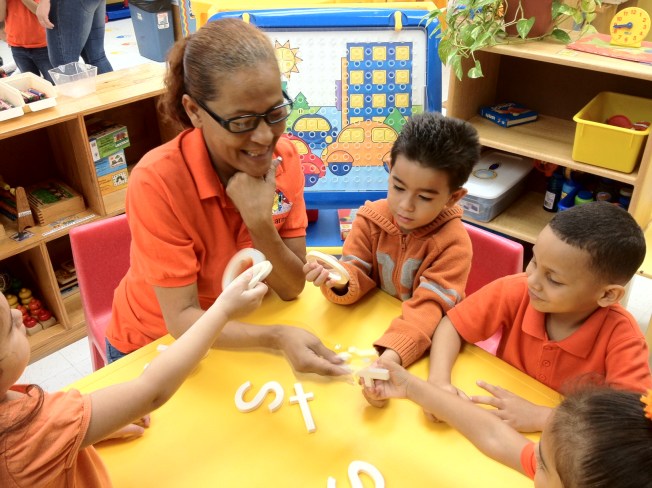
Collaboration between Rotary and Head Start builds a better future for pre-school children in Puerto Rico. Rotary Districts 7000 and 6990 initiated a literacy project that has been supported by The Rotary Foundation to provide Souns® literacy materials to 135 Head Start classrooms in the San Juan Municipality.

This yearlong literacy project included a distribution of materials in October 2012, and concluded with a distribution in January 2013.  The total of 135 sets of materials are currently in the classrooms, with each teacher participating in training for the use of those materials.  Enthusiasm is typical with teachers implementing the Souns program, as it is hands-on, engaging, simple, and effective.  “Children love it!” is an exclamation heard often. When asked, “Why? Because they are actually learning!”

It is estimated that the Souns materials distributed thus far will impact 2000 children each year, as there are no expendables in the program.

This is a good start, but the goal is to reach all Head Start children in Puerto Rico. Most immediately that means supplying the remaining 90 classrooms in the San Juan Municipality with Souns materials. Following that will be an effort to expand the program into other Head Start programs in Puerto Rico as funding is secured.

Rotary and Head Start celebrate the positive results seen from the classrooms receiving the Souns materials in the first stage of the project in October. The teachers are excited to see their children reading ready with letter-sound knowledge.

Unknown's avatar

One Sheet Fits All

DSC00005Oh, the simplicity of Souns! This is the progress sheet for a classroom or number of students from initial introduction of Souns through decoding. If you are a teacher, a glance at this sheet (if you record data regularly) will give you the information needed to re-group your children according to ability. This should be done often to sustain a dynamic learning environment.

It is important to record information or activities mastered. Souns is such a simple, fun, hands-on way to build little readers – in their time!

The classroom tracking sheet ensures classroom management. Responsible use of this tool is one of the few critical requirements of this program. After each group lesson, record any updates via the legend for each child.

Proper use of this sheet includes following the Souns sequence of letters, even when compelled to do otherwise. This order has been developed with much guidance and has been scrutinized by speech/language pathologists. There is nothing arbitrary or happenstance about the Souns program, including the order of introduction.

ONLY as a sound is mastered may you add one new sound. That means there will not be more than 4 letter-sounds being learned by a child at one time. Do not, however, stop including the sounds mastered by the child in future lessons. In this way, the child will work across the row of the tracking sheet and through the digraphs, starting with o/m/s/t and adding one new sound for each one mastered. Digraphs will be specific to the language being taught.

With this classroom overview, using the same legend as on the individual tracking sheet for each student, you can group and re-group the learners as they progress through letter-sound associations. Children should be re-grouped regularly according to their abilities. This will keep the groups and the entire classroom more dynamic and will cross-fertilize the environment with a variety of letter-sounds.

This classroom tracking sheet helps you re-organize at a glance. Legend:

Not Introduced Yet

Introduced

Knows = Learner can find or touch without error when asked for specific sound.

Mastered = Learner volunteers the sound for a letter without being asked (from print in the classroom or as the letters are being taken out of a container for a lesson).

For each Mastered sound, the child is introduced to the next new sound in the Souns sequence of letters.

Unknown's avatar

Final Results – A Year Later In SA

sounsworksknysna1

The SOUNS Literacy Programme was first introduced (through a grant from  Rotary International) into preschool classes in 2010, and a relatively small number of preschool learners in the Knysna area were taught according to the correct SOUNS methodology.

Since January 2012, thanks to a further grant from DG Murray Trust, all classes at 22 Knysna Education Trust preschools had the benefit of receiving SOUNS kits, teachers in the field were trained to present the programme in Afrikaans, Xhosa and English as required. Volunteers were trained to monitor progress in the preschools and the learners’ progress was tracked by teachers and volunteers who reported back to KET regularly. Staff at KET was able to present the programme in both Afrikaans and Xhosa, which are the usual community languages of the Western Cape.

EVIDENCE FROM GRADE 1 TEACHERS:

During the month of June 2012 [mid-school year in SA], Grade 1 teachers indicated that learners who had been on the SOUNS programme the previous year were performing well in Grade 1 literacy, with performance indicators well above national and provincial averages. Teachers reported the following levels for learners who had previously learnt SOUNS at preschools: 53% good – excellent, 30% average – satisfactory, and 16% weak.

For the entire evaluation of preschools, please click here:

Nov12- NEW SOUNS LITERACY SURVEY November 2012 (2) (then click again)

Unknown's avatar

Alongside Their Children

sounsworkspretoria2
Below is a Peace Corps volunteer’s from-the-field  report about a literacy effort she initiated.  PCV’s are such a force for good in humanity. They serve in ways that change lives in lasting ways in their assigned communities. What awesome work they do! This PCV is currently structuring a plan to sustain this literacy program past her term of service.

Her words:

           A Family Outreach Program began in three informal settlements. Tribal leaders nominated residents to serve as “Community Development Coaches.” These Coaches were trained in early childhood development, play, nutrition, and gardening. Each Coach works with ten families for two years at a time, conducting weekly home visits and teaching both parents and children together. The program targets children ages 1-5 years whose caregivers do not have a source of income (excepting social grants). In 2011, toys and books were donated to each of the families in the program. The arrival of the books prompted the Coaches to request training in literacy. In November 2012, nine Coaches were trained on the SOUNS method and began to implement SOUNS with 110 children in the program.

            Most of the children were immediately delighted with the SOUNS symbols. They readily mimicked the Coaches and eagerly handled the O-M-S-T as each sound was presented. Even the children’s caregivers were excited to participate. Many of these caregivers are illiterate, and SOUNS provides an opportunity for them to learn basic literacy skills alongside their children. At one home visit, the grandmother in charge of four young girls sat to the side, pronouncing each sound carefully and showing her granddaughters how to feel the symbol. X (pronounced “sh” in Tsonga) is already a favorite among the children who giggle every time they shush their Coach. By using the SOUNS method, the Coaches expect to prepare these children to enter Grade R on par with their peers who have attended crèche. 

Unknown's avatar

Oh, those telling eyes!

And the stories behind them…

They come in various sizes and attitudes – dressed, buttoned, tied, and tucked with hopeful fingers  – walking to school on barefoot paths. Children from the townships in South Africa live in extraordinarily challenging environments, yet they convert those challenges into creativity wrapped in endless smiles. Each has the raw potential given any child at birth. Every face confirms that potential, building a world out of whatever they have  – able to play and laugh and dream without limits. Their imaginations surpass their realities.

The appetite of the children I have encountered in the crèches and grade R classrooms to learn is heart rending and without agenda. Every moment, every bit of information is taken in with relish – smiles filled with I CAN DO THIS! The life given to a mark in the sand or on a chalkboard when it is from the hand of a child writing a word by sounding it himself or herself is magical. That spark slices right through the moment revealing eyes exploding with, “I AM ABLE!”  There is little that can match that look.

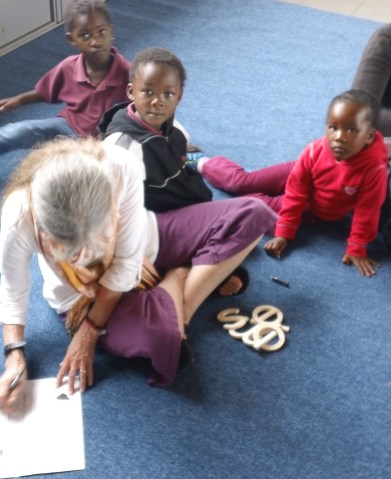
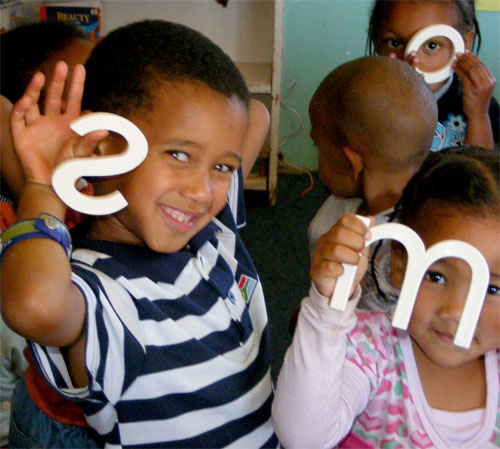
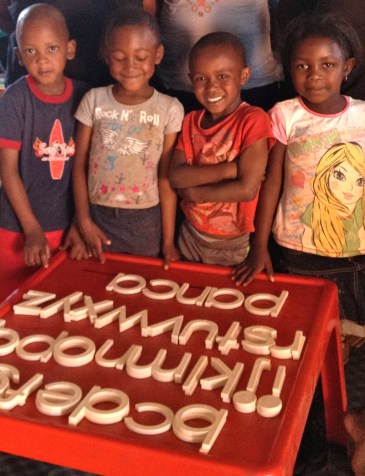
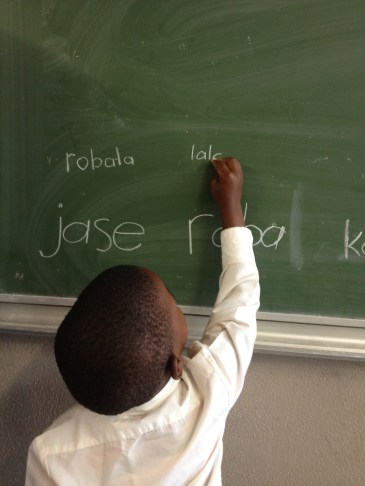
From preschool (left) to Grade 1 (below), Souns is working for these children. This Rotary literacy project between D6900 and D9400 is doing wonderful things for South Africa township children. One week of working with teachers and children from a range of crèches differ only in venue. Each opportunity was met with eager teachers and enthusiastic little people, ranging from 2 to 5 years of age. Most of the children referred to here began working with Souns last March. In those eight months they have beautifully achieved the target goals: letter-sound information for children to three; building words by listening to the sounds in spoken words for children who know their letter-sounds, usually four year olds; reading words for children five years plus. I can’t wait until our next visit in March.

Each of these children is a promising story unfolding, and the ability to write and read is a critical building block for their undiscovered dreams.

Unknown's avatar

One Leap For Literacy

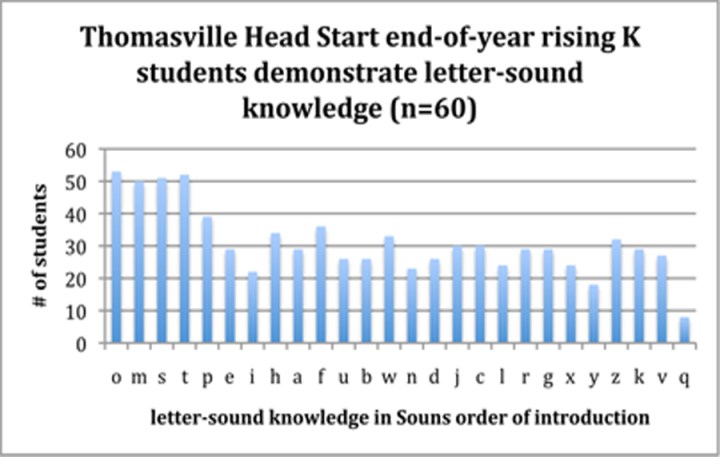
What can eight months do for literacy in a Head Start Center? Combine a furiously determined Center Director and a local Rotary Club and children will read! The Rotary Club of Thomasville, GA, and their local Head Start Center have joined in the work of literacy.

Nine classrooms – including three Early Start classrooms – began training in the Souns program in October of 2011. Several follow-up visits occurred between October and May to observe how the work was going. During the last week of school, each of the students age-appropriate to be graduating into local kindergartens were evaluated to see progress made. The results are below. It is not surprising that they reflected a direct link between those who followed the program and those who did not. The teacher is the magic that makes any program work.

This center has an abundance of remarkable teachers working with their children. After this year’s success, we expect all the teachers will see the value of this simple program for their children. It is understandably difficult to accept a program that is counterintuitive. We have been so steeped in teaching letter-names first, that the idea of teaching letter-sounds first causes resistance. Thanks to those teachers who stepped outside the box in Thomasville, children will read. The results are quite clear. Consider the data at this year’s end, when those little four year olds who are going into their second year with this program are evaluated.

We smile with tears in our eyes at what is happening in southwest Georgia. Determined people working together can make a difference. Thank you, Rotary!

Every – Yes, every – child will read.