Unknown's avatar

Giggles, Letter-Sounds, Results!

longview10-13-4


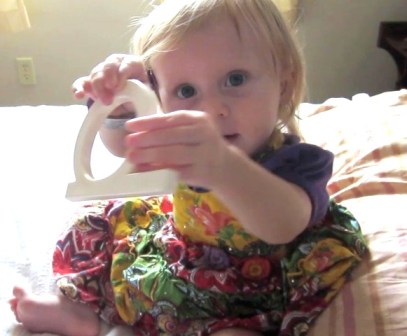
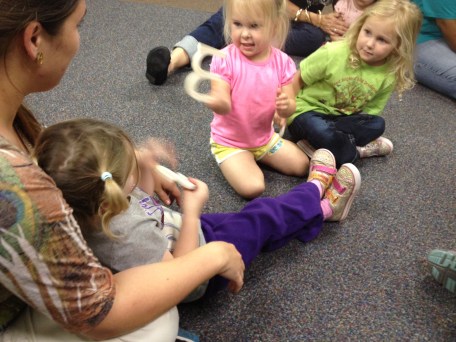
It was such a treat to train preschools in Longview, Texas, today. The bright-minded teachers and the eager children made the experience exceptional.  We trained teachers for 12 classrooms and enjoyed the assistance of a few little ones to demonstrate the fun one can have learning letter-sounds.
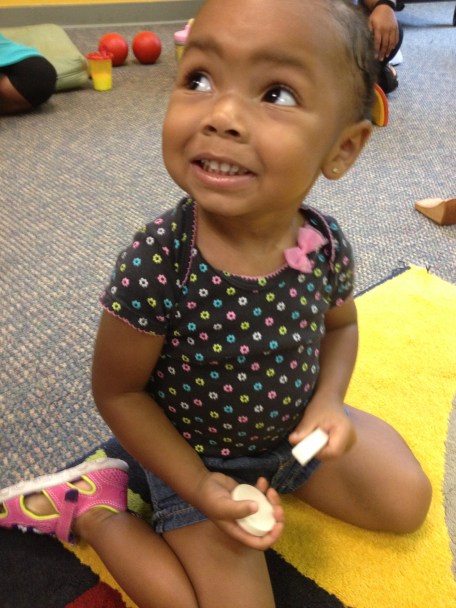
Longview10-13Large smiles from those teachers and giggles from their little people painted a promising picture for early literacy in this community. Four children of different preschool ages and abilities played with Souns as teachers were trained to implement the program. Amazingly, play is the teacher. When learning is fun, the timing is right, and the hands are involved, school looks very different to a child.

And it works! One public preshcool in Longview began implementing Souns in eleven preschool classrooms this year in September. Today they ordered materials for three more classrooms. Results are clear – Souns is making a difference. Consider this letter that greeted me in an email today from a preschool using Souns in Colorado. It is from parents celebrating the reading ability of their Souns child who graduated from the preschool and is currently in kindergarten. We are grateful for such sharing.

I was told that you called the other day to follow up on the [Souns] reading program you did this past year.  I longview10-13-5wanted to send you the picture of [my daughter] as September’s super reader for her Kindergarten class.  I gave her teacher the letter you had given in regards to the Souns program.  She is reading now and just the other day read 5 books in a 15 minute period. When we do spelling words with our older son, our daughter is able to spell many of them just because she knows what sound the letter makes!   Thank you so much!!  The only downside is that she said she hasn’t learned anything new in Kindergarten yet!!  I suppose that is a problem that can easily be fixed!!

Build her library and stand back. A reader will always be learning. Once a child can read, you can’t take that away!
longview10-13-2


Unknown's avatar

She Found An /e/!

Paisley’s Mom Shares!

Recently, Souns are Paisley’s favorite thing to play with.  At least a couple times every day she goes to where we have them sitting with her toys in her room and she gets the bag and brings them over to me and starts pulling them out.  Sometimes she identifies them as she is pulling them out, sometimes she just wants to look at them, and sometimes she looks for a specific one (usually p).  She especially likes them at night or in the morning.  A couple days ago she told me “Book.  Read.”  And I said, “Sure, Paisley, let’s put your diaper on and then you can go pick a book and we can read whichever one you want.”  She got excited about that and exclaimed “Read!  Cool!”  So we finished putting her diaper on and she went over to her books…and without even looking through the books to choose one she immediately grabbed the bag of Souns and brought it back over to me.  That surprised me.  I don’t know whether she had them in mind all along or whether she saw them next to her books and changed her mind when she went for a book.

I think one reason she especially likes to play with the Souns is because of an activity we sometimes do with them and the bag.  A while ago I started doing something where at night, if we hadn’t used the Souns during the day, I would pick them up (before we were using the bag, when they were just out) and we would say goodnight to them as we put them away back on her shelf.  And that was it.  If she was interested in the activity, I included her, and if she wasn’t interested I just quickly did it myself so that she saw one association for each sound/letter pair for that day, in 10 or 15 seconds.  It was a quick activity.

Now that we are using the bag to contain her Souns, the activity is more fun for her because there is the fun put-things-in-pull-them-out element. We dump all of the Souns out on the bed.  I orient them properly so that she can see them and they are facing the correct way, and then in a random order I ask her to put them back in the bag, and we say goodbye (or good night) to each of them.  “Paisley, will you put the /s/ in the bag?  Bye, /s/, we’ll see you next time!  Look, the /s/ is ssstuck on the edge of the bag.  /s/ likes to get ssstuck when you put him back in the bag!  Can you put the /t/ in the bag?  Bye, /t/, we’ll see you soon!” etc.  She loves that game.  

Paisley often notices letters that she knows on things.  She didn’t sleep much on a recent flight so she had a little burst of energy and was walking around [the airport] while we waited for our luggage. Then she started saying “e” “e” “e” so I pulled out the camera to ask her about it.  (The end is a little dramatic, but don’t worry, she was actually fine, no tears or bumps.)She even started waving to it! 
Unknown's avatar

Observe! Your Child Is Your Teacher.

image

With the best of intentions, our timing and our direction are off! We are missing the most sensitive period in a child’s life to teach the fundamental tools of writing and reading if we do not engage between 0-5 with letter-sound associations. Lower-case letters and the most common sound for each letter is the simplest tool box leading to literacy.

Letter sounds taught kinesthetically with clay, cookie dough, or Souns, using only lower-case letters is so simple and logical. Engaged hands feed developing brains, say the directions that come with this little package called “child.”  Watch a child play, touch, manipulate, explore…all words reflecting engagement with the world. Digging, stacking, building, lifting, carrying – these are the efforts and endless work of the child acclimating to the world around him or her. As adults, we are so driven to teach; yet, if we paused and observed, we would understand ourselves to be the learners. Children know more about how they learn best than we do; but, too often we are not watching.

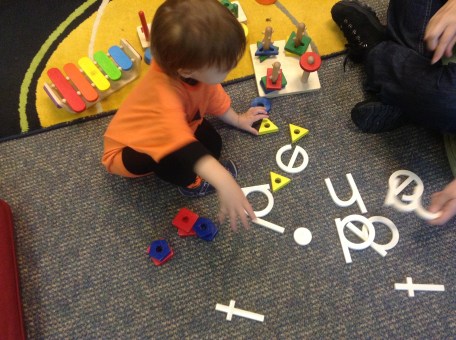
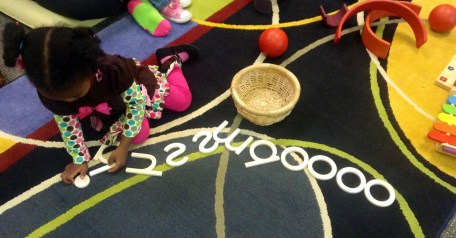
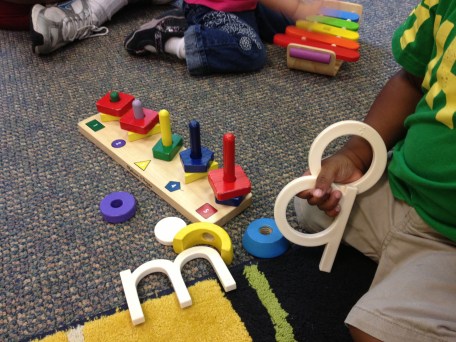
Today, at our Souns early literacy workshop, we took the time to watch. The images show you what we saw: stacking, matching, lining up, sorting – all the while learning letter sounds. Why not? They learn shoe much before they can put one on. They learn bath, well before they can run their own. Similarly, they can learn /o/m/s/t/ and on through the letter sounds of our alphabet. They are just objects being labeled, the same as a cup or a triangle. If we can keep it simple, they will learn. Look at those little hands and the activity we observed this morning. Enjoy your child. Observe and learn.

image

Unknown's avatar

Perhaps We Have It All Backwards

photo-203

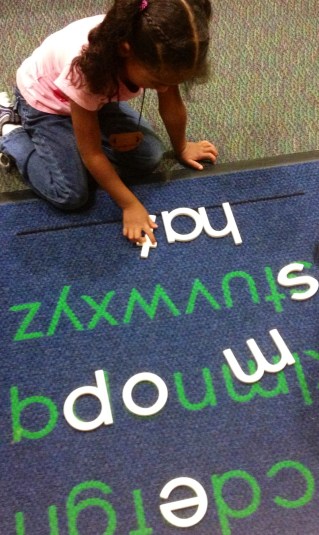
     A preschooler building a word by listening to the sounds in it.

This past week I was surrounded by incredible people – parents, teachers, administrators, and friends – all grappling with the huge need to better prepare preschool children for success in school. One administrator’s comment, “Our kids are well prepared for kindergarten, except they do not know their letter-sounds!” gives critical direction for the litter-strewn path to reading and writing. Our culture insists on prioritizing the 26 letter names, of which only 5 are used for reading and writing. On the other hand, all 26 letter- sound associations are directly linked to reading and writing. Why do we have it backwards?

Monsters – marketing, fear of failing our children, crippling schedules, and rigid curriculum – invade every discussion, home, and classroom. The front line of education, reading and writing, has been engulfed in a dense, blinding, consuming fog. We can’t see the hand in front of us! We can only hear the shouting voices from every direction. Which do we follow?  Which voices are serving our children?  Which are serving political or financial agendas? The child waits, holding on with complete faith as we scramble to find our footing for the next step.

Such a cacophony can “blind” us to the obvious?  Perhaps we should not be leading the child! Perhaps the child should be leading us! Children are the experts about how they learn best. Research confirms how rapidly the brain is developing between 0-5 years of age. The young child is uniquely programmed for language learning, and, if introduced incrementally, reading and writing fits comfortably and naturally along side language learning. In education design, preschool, not kindergarten, is the time for learning to read and write. That is not the case now. It seems we may have that backwards, too?

Unknown's avatar

The Souns Path to Reading = FUN!


This is a Souns child who is 3 years and 3 months. She has arrived at this point in reading incidentally, without pressure or any formal “schooling.” Her Souns experience began as a toddler and unfolded as naturally as learning to eat or dress.

The joy is clearly there, having been protected by a gentle incremental approach to letter-sounds without the presence of letter-names. Letter-names will be a focus later, when she is 4-5 years of age. Consider her reading at the magical 3rd grade level and think of the world of children we are missing. The right information at the right time and in the right way makes a profound difference.

Her father said she cried when they asked her to stop! Motivation is not a problem if the timing is right.

Unknown's avatar

A Bowl Of Souns

sounsclasses2boys

A typical moment in the Souns Early Learning Workshops! One mom wrote her story:

“My daughter was born on August 2011. She  was introduced to Souns at our library through a project of the local Rotary Club. We attended on 2 occasions; on January 2013 and March 2013.  Specifically, we [were intoduced to] the Souns letter  /o/.  Since we did not own a set of Souns, I used one of her toys shaped like an o to reference the /o/ sound.  

 
At the end of March 2013, my child pointed to an /o/ on her placemat at dinner and exclaimed, ” Ah!”
 

[Our family] started the every other Friday Souns Early Literacy Workshops at Counterpane Montessori school on August 2013 where our [daugter] was introduced to m, s and t.  My mother and her husband purchased a set of Souns for my daughter on that day.  Within a few weeks, my 2 year old daughter brought me her bowl of Souns.  She held up her m, o, s and t and said,” mm, ah, ss, and tih!”  We celebrated and she was introduced to /p/ and /e/.”  

Playing to learn works! The video below is where the little one in the story above will likely be in a year. She is 3 years 2 months in this video. Importantly, there has been NO pressure to “learn to read” or “school” to compromise the joy of learning through play.

Unknown's avatar

A Jewel In Colorado!

dellavisit13

This lovely woman, Della Palacios, is now living in Boulder, Colorado. One of her offerings is Souns and Rhymes classes for little people. Get to know this remarkable talent. I celebrate that she is a Souns trainer as well!

Souns and Rhymes

The design of this class is to establish a foundation so firm that no holes will ever appear in fundamental literacy skills. It’s a simple brilliance that makes it so profound.  Souns® and Rhymes classes consist of two core elements: letter sounds and nursery rhymes.  Parents interact with children as language and literacy is brought to life.

I used Souns with my children and taught them nursery rhymes, but it was not until they were three and four years old.  Now, I am having the pleasure of watching one-year old babes learn nursery rhymes and letter sounds.  Two weeks ago, a 16 month-old said “row row row” in eager anticipation of “Row, Row, Row Your Boat.”  Another 17-month old pointed out the “mmm” when asked on the poster displaying the rhyme “mary had a little lamb.”  She connected the label of the Souns symbol, /mmm/, to the print on the poster.
 
Simple is best.  Teach children nursery rhymes.  Teach children letter sounds with lower case letters first.  Children will read.
Unknown's avatar

Paisley’s Souns


Panama 018

A Souns Mom Shares! 

“She loves her Souns!  We are doing some extended travel [and mail is an issue].  It would have been a lot easier to just order the whole set to begin with, but we had never seen them in person or known anybody to use them, so we didn’t know if we would even like them or use them.She’s learning so quickly.  I had no idea kids could learn this stuff so early!  Sometimes we talk about Souns as we are reading stories (/m/ /o/ /m/, or /p/ /e/ /t/, especially) and she just soaks it all up.

That reminds me of one other thing–when I introduced /p/ and /e/, it was as if Paisley already knew them, and was glad to finally know what they were.  She was delighted!  (Especially with her /p/.)  I’ve been thinking about it, and I think Souns are especially good for her because she talks so much, and since she is still little, when she verbalizes different words her speech is obviously not as clear as an adult’s.  She sometimes thinks it is funny that words in English sound alike.  For example, she is always asking me what things are, and one thing she asked about recently was the sheet on her bed.  So I told her, “Sheet.  That’s called a sheet.”  She was really surprised and amused by that.  “BAAA!”–she grinned–“Sheep!”  OH!  Yes, those words sound very similar, don’t they.  I explained it to her and sounded the words out clearly and slowly…but that is fairly typical.  Souns make it easier for me to help her differentiate between very similar words because they give us a shared frame of reference and they help separate sounds that are related to one another but different.  I think that will continue to be the case when we are able introduce more.

She loves “reading” (just flipping through pages of her books, mostly silently), and being read to, and this past week I offered her a pen and paper and she finally loves to scribble…so it will be very interesting to see how Souns continue to shape her learning.  We’re having a lot of fun with this!”

Unknown's avatar

“The Brain Is Never NOT Learning!”

sounsworkshop83013-3

Observation of a very young child shows an endless stream of exploration: input, input, input to a developing brain. Watch the eyes followed by the hands followed by the mouth.  A spot on the rug is intensely explored. A smooth painted geometric shape is examined, moved from hand to hand and to the mouth until interest is diverted to another child doing something nearby.  All eyes, hands, feet, mouth, ears feeding the brain by engagement with the environment, examining every detail with attention rarely matched in later years.

Look at the toys in this morning visit.  All designed for little hands and minds to explore: geometric shapes and letter shapes; stacking toys and building toys.  “This is an /o/.”  “That is a rectangle.” “Thank you for the red ball.” Simple comments, short, gentle, and to the point leaves space for the child’s mind to consider the information in their own time.

sounsworkshop813

It is very interesting to watch creative little hands try to stack and sort in a very personal way.  It is in our patient watching that we are able to see the learning happen. We must be still and not interrupt the direction of the play except to keep children safe. A surprise presents itself in every visit if we observe and let the exploration happen. “The brain is never not learning!” I love those words of Patricia E. Wolfe in Mind Matters.

“Yes, little one…that is the letter for /i/!” They find so much confidence in just KNOWING!

Sounsworkshop83013-2