Unknown's avatar

One Preschool – One School Year!

Souns® for Literacy in the GET-SET Preschool in Colorado Springs, Colorado, USA

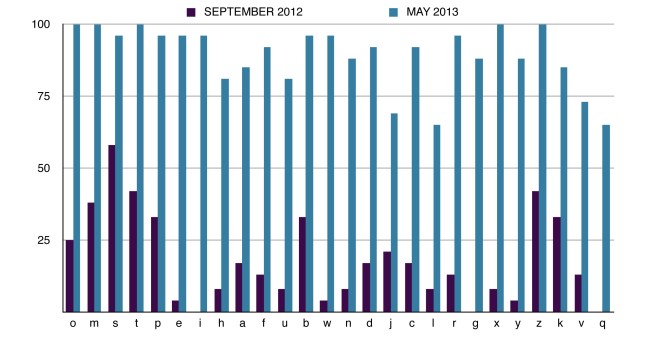
SounsGetSetletters2013This graph – in percents – represents letter-sound knowledge for learners (N=34) in the GET SET preschool classroom, comparing data collected at the beginning of the school year and at the conclusion of the school year. Consider the future step into kindergarten for these children.

 While in a separate graph, it is important to mention that the majority of the learners knew 6 digraphs, and could sound out 9 phonetic words. It is awe inspiring to see the potential awaiting classrooms when children are supported and learning is fun. The focus on letter-sound associations in exclusion of letter-name associations (until decoding begins) clearly makes a difference in building young writers and readers.The Souns program is evidence based and it works! Thank you, Rotarians, for the gift of Souns! Thank you teachers and volunteers of GET SET for ensuring that our  c h i l d r e n   w i l l   r e a d !

Unknown's avatar

The Power of “Working Alongside!”

photo-199

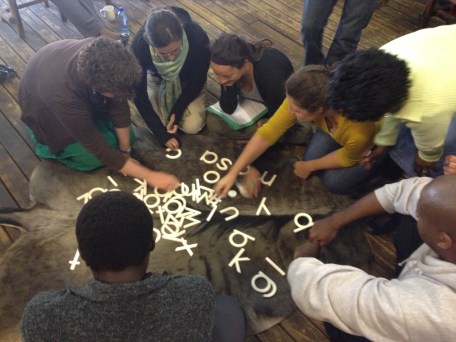
I am in a van on the road to Peace Corps Inservice Training (IST) in South Africa. Such beautiful hearts and minds sit with me. Grace, courtesy, warmth, and enthusiasm are constantly present in this organization’s efforts to better the world. I have been on this same trip to different sites on several occasions to train volunteers to implement our Souns for literacy program. I find it an equally positive experience each time.

PCV’s (Peace Corps Volunteers) have an energy and a flexibility that are bound to make a difference for their communities as their terms progress. One volunteer on this trip is doing what so many do, extending their term an additional year. PCV’s are making a difference and they feel it and often do not want to end the experience. The other side of the story, of course, is that the volunteers are learning more about themselves than can be measured on a calendar. The lessons will affect them for a lifetime. I think of it as tracking their future. Each of us has a gift already in place, but it is only discovered and confirmed through experience.

In the words of one PCV:

“Working alongside people who struggle to put food on the table, yet who have welcomed me into their lives and hearts has allowed me to see the great potential in the rural areas, and has motivated me to extend my service beyond the usual two years.  As I work to teach new skills, I am learning what it means to be part of a global community that transcends culture, ideologies, and language.”

Tomorrow I will be “tracking” my future, doing what I love most (next to doing a walk-about in my mind along a warm beach somewhere) – I will be introducing PCV’s to the Souns program. Those who find it compelling will be trained and will receive sets of Souns provided by The Rotary Foundation through a Global Grant project sponsored by RD9400 and RD6900. PCV’s are reaching thousands of children, making a difference one child, one village at a time. What a pleasure it is to be wrapped around with such purpose.

photo-199 copy

 And it was so much fun!

Unknown's avatar

Head Start Graduates – Two Years Compared


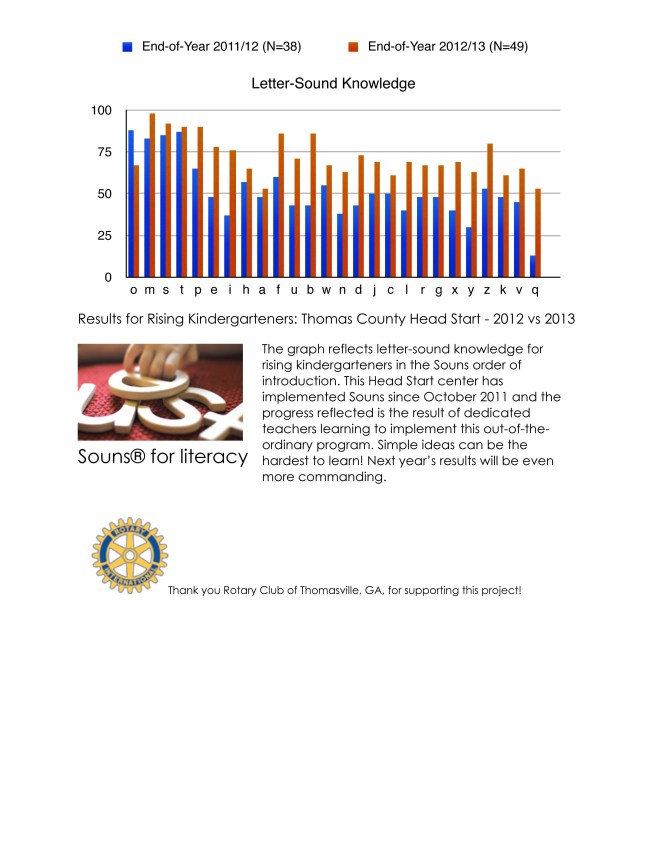
   Percent Of Head Start Graduates Who Demonstrated Letter-Sound Knowledge

The teachers are responsible for improved success of graduates! They are committed to helping their children read!

SounsHSthomasvillegraph12:13

Unknown's avatar

Voices!

sounspuertorico

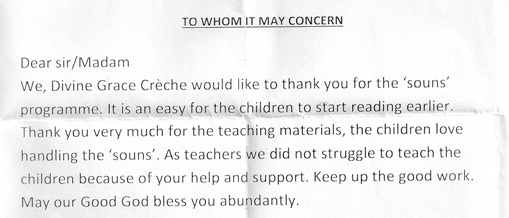
Today ends our federal review. We came out excellent. We talk to federal about SOUNS and [they] were delighted.” A note from Head Start in San Juan about our project in Puerto Rico with 4000 children.

“Our club is giving Souns to a large center near us!”  from the President Elect of Rotary Club of Bainbridge in southwest Georgia. That is the largest center in the SWGACAC program and they have been using only two sets of Souns for 13 classrooms. Now, thanks to Rotary D6900, they will be fully supplied with Souns.

A note from South Africa:

image

Unknown's avatar

Pave Road To Literacy With Play!

photo-192

Children are our teachers! Observing how they learn teaches us how learning happens best…for any age. To build literacy, play is the way for children to learn the fundamentals of print. We can shelve all the manuals, the quick fixes, the how-to’s, and the flash cards, and follow the child to what is needed. Intentional activities that are play-based, meandering by design with the exploring mind of the child, teach us how specifically the hand defines the brain. Every detail is measured and absorbed. Be still, watch, and you will see.

A playful day with one of the families:

We had such great weather last weekend, we were able to get outside a bit. My daughter loves to play with chalk, so my husband and I drew out her souns on the driveway. We asked her (and each other) to go stand, sit, hop, whatever we could think of on her souns. We all had a blast!

We will be exploring with the child as we get our hands into some play dough. The recipe link:  http://www.mommypotamus.com/homemade-play-dough-recipe-with-natural-dyes-and-a-gluten-free-option/

One parent’s approach to this recipe:

I used the regular recipe with 1/2 cup of cranberry juice and 1/2 cup of water (and no essential oils) and it came out a very pretty pink. I keep it in an airtight container; I made it over a month ago and it’s still fine. Like I mentioned in class, my husband and I have fun with it but my daughter really won’t touch it (yet).

Till next time:photo-196

photo-192

Unknown's avatar

Building Words – A Bridge to Reading

photo-191One way or another we learn letter-sounds and apply that knowledge directly to learning to read. For the most part it works, but not without notable levels of difficulty and frustration.

One additional step can make a commanding difference in that journey to reading – building words. Consider a 1000 piece puzzle. Putting it together can be challenging for anyone. Taking the completed puzzle apart into its individual pieces to be returned to the box is quite simple by comparison.

Learning to read is like negotiating the loose puzzle pieces of our alphabet, turning a chain of sounds into a word. It is quite challenging and can lead to many failures and much guessing before success is enjoyed.

Consider the ease of taking the puzzle apart. A spoken word is like a puzzle already put together. All the sounds are there in a nice little package called a word. If the child knows letter-sound associations well, listening to the sounds and building the word – one sound at a time – (not as it is spelled) is quite confirming and informative for the child.

This step – building words – bridges code based knowledge and decoding. Children 4 and 5 years old and those challenged as readers need to develop a deep understanding of how words are built. A child who knows letter-sound associations well and who focuses on building words – one phonetic sound at a time – for several weeks to a month often transitions into reading words seamlessly.

Reading becomes the next natural step for the child who has built words by listening to sounds in words first. This has been the magic of the Montessori-minded Souns program. IT is a direct link between sound and symbol, bypassing letter formation, which is another skill altogether.

Unknown's avatar

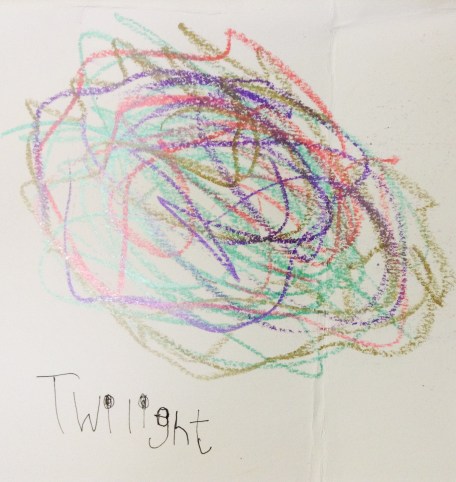
T w i l i g h t – “It IS a poem!”

photo-191

Be still, observe your child! Watch that little developing mind explore, examine, attend to every nuance in the world around it. You will be in awe at the attention to details. The extended gaze, the second glance, the questioning look, the twinkle of confirmed knowledge, the determination – all threaded by no more than a string, a crack, an ant,  a shadow, a drop of water, or a new face. Every piece of life matters in the construction of the brain. This building of a person offers no trailer, no quick view, no short cuts. There is no time when the brain is not learning (P. Wolf).  The senses are the tools that feed the brain, and they must be allowed to do their work. Gently watch your child, and he or she will show you who they are in their endless quest to become that unique bundle of talents they have unfolding within them.

The “poem” above is one mind telling us its story. Young children have SO much to say. Are we listening? Are we watching? Are we willing to be amazed?

The “poem” is from a Souns child that had just turned 5. 

Unknown's avatar

Memories – the STUFF of our stories!

sounsworkkwatu2

khwattu13The door of the little museum shop at Khwa ttu was closed. The rippled glass pane in the antique double doors confirmed there were people inside. I turned the handle and the door opened to quiet conversations inside.

As if scripted, the lady behind the counter and I exchanged glances and time melted.…the look on her face mirrored mine. Oh, how good is that warm feeling of seeing someone you have so enjoyed in times past. Memories are real! They breathe life into those moments when we touch the past, paging through history to the sentence, the paragraph, the story.

Wrapping each other in hugs and smiles, we revisited the little class of preschoolers at Khwa ttu, of which her child was one. Four years earlier I wandered into the facility intrigued by the call of the billboard on the highway – San Cultural and Educational Center.  The story of man, specifically the bushman of South Africa, was compelling.

Khwa ttu was the beginning! A little class of children two to three years old and their hopeful moms was such a treat. The tiny facility, the little shaded play area, the magnificent view of the Atlantic, the willing minds and eager hearts imprinted my world forever. Visit after visit I came to train or teach, as they wanted. Then, the government closed the bit of heaven. Reasons are of little importance. I had lost my heart.

Nonetheless, each trip to South Africa I made my way up the long entry road to Khwa ttu in hopes of seeing the children, hearing the laughter behind the two neatly aligned stick windbreaks. I would ask for the families I had gotten to know. Fewer and fewer of them were at the center.  Finally there were none left that I knew.

But still I returned, hoping for an encounter with the past. This time the past was there to meet me, confirming that the time given in that little class had made a difference for a family and their child. The child is 7 now and loves to read. That is the gift.

Memories are powerful, especially when they meet head on with the present. They are the stuff of our stories…our lives!

sounsworksafrica3

Unknown's avatar

A Few Weeks Ago

Professional31-239x300

Della Palacios  @sensablelrning

A few weeks ago I met a young man who, due to life’s circumstances, started school many years after most children.  His native language is Spanish, although I would not have known as he spoke so well.His caregivers called me to see if I may be able to help him with his reading.  The computerized assessment he was given had him reading at a primary level, even though he is a freshman in high school and is several years older than most of the others in his class.

When I arrived, I introduced myself and explained that I am like a reading detective, trying to figure out what’s going on.  He was very polite so when I asked if he struggled, he answered simply, “Yes, ma’am.”  

I started like I always start with older learners, with a Sound Check using #Souns.  It was evident pretty quickly, he only knew letter names and was trying to convert them into some variation.  He did not know any sounds besides /f/ when I went through the first half.  I stopped there as I didn’t want to embarrass or frustrate him and thought carefully about what reading passage I wanted to begin with.  

I should mention here that the computerized reading assessment ‘s results said he knew his beginning sounds and blends?!

I pulled out a few phonetic phrases and he read them fine.  I looked at him and said, ”Wow.  You are smart.  You have memorized an awful lot of words to be able to read to me what you just read.”  Again, he answered, “Yes, ma’am.”

So, I told him that learning his letter sounds will help.  It will help him figure out new words he hasn’t memorized.  We began and after practicing with a number of Souns at a time, he wrote.  He wrote pot and mop and dog and cat.  Three letter words were difficult for him.  This is not at all surprising as it reveals the confusion with the short vowel sounds that get well hidden by word memorization.  I asked him if he remembered how they taught him to read when he started school since he started late.  He said the first book he every read was “Up and Down” and he recited it to me.  It sounded like a sight word book.

So we continued to work and build.  I would hear him going through the sounds in front of him while I was fumbling through the tub with the Souns symbols.  I asked if he thought it would help him and he said, “Yes, ma’am.”  He shook my hand and thanked me quite genuinely for coming before I left. 

I went to meet with him a few more times.  Both visits were the same: sound practice, word construction, and basic reading practice.  By the end of the last session, he recalled 21/26 letter sounds and three of the six digraphs.  The vowels are still the most troubling.  

The most telling thing about his reading experience thus far was the miscues that he did as I asked him to read passages for me.   We read from the McGuffey Reader.

Instead of pen, he read open.

Instead of pen,  he read pan.

Instead of run, he read ran.

Instead of song, he read sound.

Instead of pond, he read pound.

Instead of bank, he read blank.

Instead of bead, he read bread.

instead of beak, he read bake.

Instead of quite, he read quietly.

Shapes of the words were similar.  The words looked a lot like the others.  He is putting in so much mental energy into recalling each individual word, comprehension is not happening.  He is extremely bright, so once he does catch on to and start processing the language code, I suspect reading will improve.  The time and practice must take place, though.

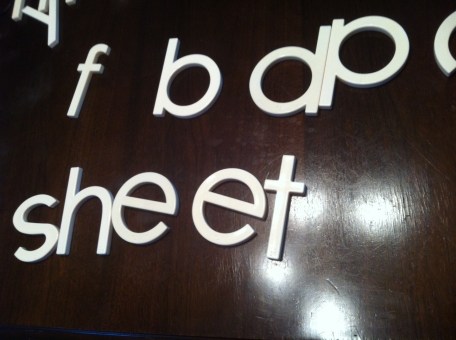
sheet


Unknown's avatar

It Is Through The Hands That We See

image-1

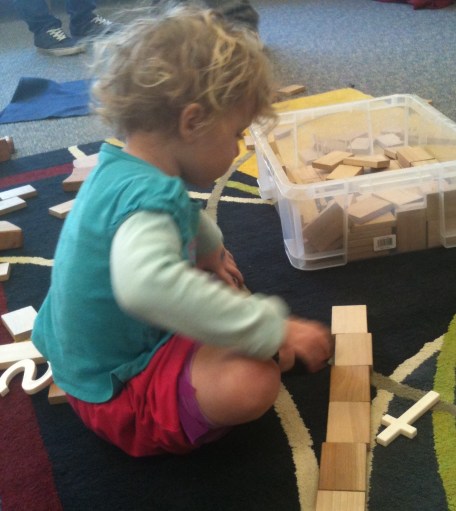
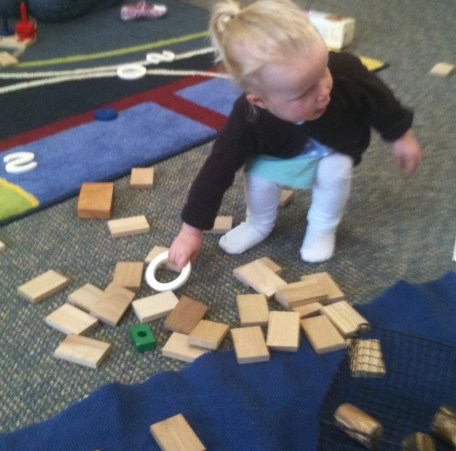
Another beautiful morning observing, discussing, and exploring “child” at Counterpane’s Free Early Literacy Workshops. Follow the hands and find learning. Information about “the hand and the brain” can be found in Lillard and Jessen’s Montessori from the Start: The Child at Home, from Birth to Age Three.

image3-8-13