Unknown's avatar

The Souns Path to Reading = FUN!


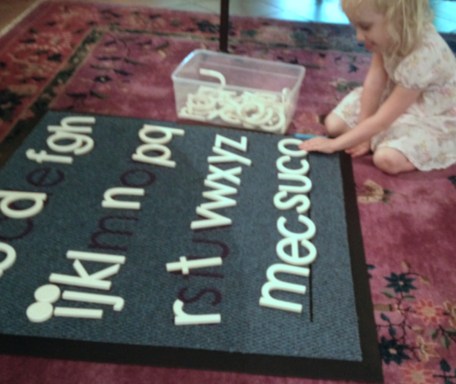
This is a Souns child who is 3 years and 3 months. She has arrived at this point in reading incidentally, without pressure or any formal “schooling.” Her Souns experience began as a toddler and unfolded as naturally as learning to eat or dress.

The joy is clearly there, having been protected by a gentle incremental approach to letter-sounds without the presence of letter-names. Letter-names will be a focus later, when she is 4-5 years of age. Consider her reading at the magical 3rd grade level and think of the world of children we are missing. The right information at the right time and in the right way makes a profound difference.

Her father said she cried when they asked her to stop! Motivation is not a problem if the timing is right.

Unknown's avatar

A Bowl Of Souns

sounsclasses2boys

A typical moment in the Souns Early Learning Workshops! One mom wrote her story:

“My daughter was born on August 2011. She  was introduced to Souns at our library through a project of the local Rotary Club. We attended on 2 occasions; on January 2013 and March 2013.  Specifically, we [were intoduced to] the Souns letter  /o/.  Since we did not own a set of Souns, I used one of her toys shaped like an o to reference the /o/ sound.  

 
At the end of March 2013, my child pointed to an /o/ on her placemat at dinner and exclaimed, ” Ah!”
 

[Our family] started the every other Friday Souns Early Literacy Workshops at Counterpane Montessori school on August 2013 where our [daugter] was introduced to m, s and t.  My mother and her husband purchased a set of Souns for my daughter on that day.  Within a few weeks, my 2 year old daughter brought me her bowl of Souns.  She held up her m, o, s and t and said,” mm, ah, ss, and tih!”  We celebrated and she was introduced to /p/ and /e/.”  

Playing to learn works! The video below is where the little one in the story above will likely be in a year. She is 3 years 2 months in this video. Importantly, there has been NO pressure to “learn to read” or “school” to compromise the joy of learning through play.

Unknown's avatar

Paisley’s Souns


Panama 018

A Souns Mom Shares! 

“She loves her Souns!  We are doing some extended travel [and mail is an issue].  It would have been a lot easier to just order the whole set to begin with, but we had never seen them in person or known anybody to use them, so we didn’t know if we would even like them or use them.She’s learning so quickly.  I had no idea kids could learn this stuff so early!  Sometimes we talk about Souns as we are reading stories (/m/ /o/ /m/, or /p/ /e/ /t/, especially) and she just soaks it all up.

That reminds me of one other thing–when I introduced /p/ and /e/, it was as if Paisley already knew them, and was glad to finally know what they were.  She was delighted!  (Especially with her /p/.)  I’ve been thinking about it, and I think Souns are especially good for her because she talks so much, and since she is still little, when she verbalizes different words her speech is obviously not as clear as an adult’s.  She sometimes thinks it is funny that words in English sound alike.  For example, she is always asking me what things are, and one thing she asked about recently was the sheet on her bed.  So I told her, “Sheet.  That’s called a sheet.”  She was really surprised and amused by that.  “BAAA!”–she grinned–“Sheep!”  OH!  Yes, those words sound very similar, don’t they.  I explained it to her and sounded the words out clearly and slowly…but that is fairly typical.  Souns make it easier for me to help her differentiate between very similar words because they give us a shared frame of reference and they help separate sounds that are related to one another but different.  I think that will continue to be the case when we are able introduce more.

She loves “reading” (just flipping through pages of her books, mostly silently), and being read to, and this past week I offered her a pen and paper and she finally loves to scribble…so it will be very interesting to see how Souns continue to shape her learning.  We’re having a lot of fun with this!”

Unknown's avatar

“The Brain Is Never NOT Learning!”

sounsworkshop83013-3

Observation of a very young child shows an endless stream of exploration: input, input, input to a developing brain. Watch the eyes followed by the hands followed by the mouth.  A spot on the rug is intensely explored. A smooth painted geometric shape is examined, moved from hand to hand and to the mouth until interest is diverted to another child doing something nearby.  All eyes, hands, feet, mouth, ears feeding the brain by engagement with the environment, examining every detail with attention rarely matched in later years.

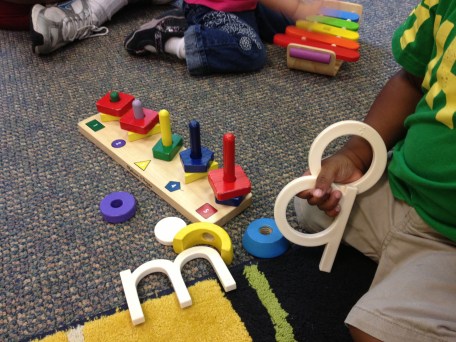
Look at the toys in this morning visit.  All designed for little hands and minds to explore: geometric shapes and letter shapes; stacking toys and building toys.  “This is an /o/.”  “That is a rectangle.” “Thank you for the red ball.” Simple comments, short, gentle, and to the point leaves space for the child’s mind to consider the information in their own time.

sounsworkshop813

It is very interesting to watch creative little hands try to stack and sort in a very personal way.  It is in our patient watching that we are able to see the learning happen. We must be still and not interrupt the direction of the play except to keep children safe. A surprise presents itself in every visit if we observe and let the exploration happen. “The brain is never not learning!” I love those words of Patricia E. Wolfe in Mind Matters.

“Yes, little one…that is the letter for /i/!” They find so much confidence in just KNOWING!

Sounsworkshop83013-2

Unknown's avatar

Compelling Success In South Africa

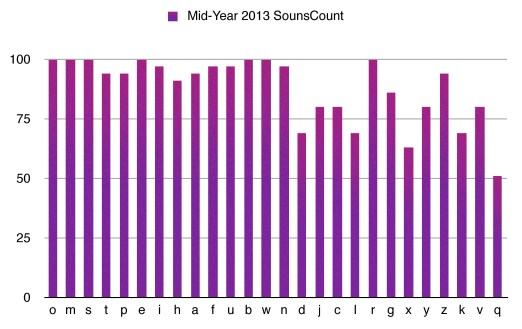
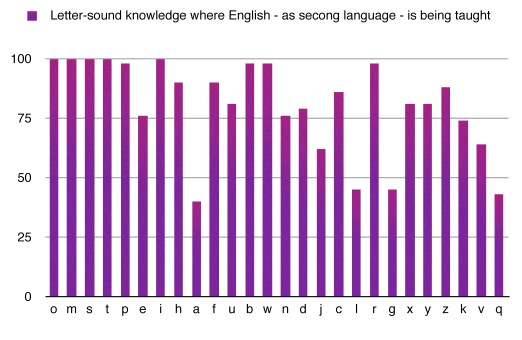
SounsCount: Mid-year assessments for two Grade R classrooms: One where learners are taught in home-language (N=35) and one (N=42) where they are taught in second language.

graphimageshollo5-13

The  5 year old children from these two Grade R classrooms in the township of Mamelodi* began their work with Souns in January 2013, several weeks after the beginning of their school year. These assessments were administered in late May 2013. Considering school holidays and only a portion of their year completed, the results (percents) are stunning. According to the teachers and our observation, building words and sounding out words – the application of letter-sound knowledge –  are regular activities in the classroom. When the school year ends in December, the learners will be well on their way to a successful school year in Grade 1.

While each classroom is demonstrating notable success, there is a distinct difference between the class which is teaching children in their home language (above) and the class where children are being taught English (below), a second language for the learners. It will be interesting to see the results as the children in the two classrooms continue through the Souns program.

LukiNelmapius5-13

Based on the joy we witnessed in the classrooms, these children are learning the fundamental skills of writing and reading – letter-sound associations – with fun and exploration. The teachers are engaged with the program and excited about the results. Souns® works!

This is a Rotary literacy project initiated by Rotary Districts 6900 and 9400. Thank you, Rotary Club of Pretoria East in RD9400 and Rotary Club of Peachtree City in RD6900. Children have a better path ahead because of you and the The Rotary Foundation.

*Mamelodi is a township of over a million population: http://www.mameloditrust.org.uk/photos/photo_about1.jpg

Unknown's avatar

One Preschool – One School Year!

Souns® for Literacy in the GET-SET Preschool in Colorado Springs, Colorado, USA

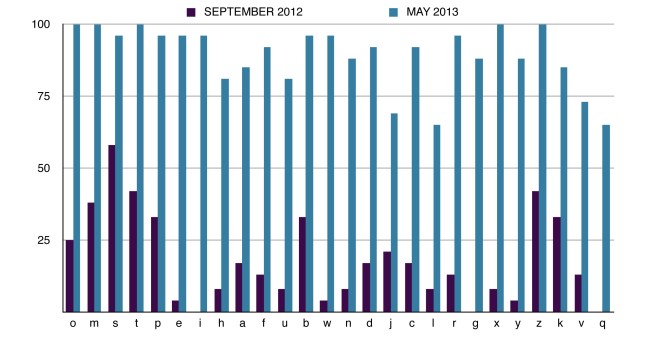
SounsGetSetletters2013This graph – in percents – represents letter-sound knowledge for learners (N=34) in the GET SET preschool classroom, comparing data collected at the beginning of the school year and at the conclusion of the school year. Consider the future step into kindergarten for these children.

 While in a separate graph, it is important to mention that the majority of the learners knew 6 digraphs, and could sound out 9 phonetic words. It is awe inspiring to see the potential awaiting classrooms when children are supported and learning is fun. The focus on letter-sound associations in exclusion of letter-name associations (until decoding begins) clearly makes a difference in building young writers and readers.The Souns program is evidence based and it works! Thank you, Rotarians, for the gift of Souns! Thank you teachers and volunteers of GET SET for ensuring that our  c h i l d r e n   w i l l   r e a d !

Unknown's avatar

Building Words – A Bridge to Reading

photo-191One way or another we learn letter-sounds and apply that knowledge directly to learning to read. For the most part it works, but not without notable levels of difficulty and frustration.

One additional step can make a commanding difference in that journey to reading – building words. Consider a 1000 piece puzzle. Putting it together can be challenging for anyone. Taking the completed puzzle apart into its individual pieces to be returned to the box is quite simple by comparison.

Learning to read is like negotiating the loose puzzle pieces of our alphabet, turning a chain of sounds into a word. It is quite challenging and can lead to many failures and much guessing before success is enjoyed.

Consider the ease of taking the puzzle apart. A spoken word is like a puzzle already put together. All the sounds are there in a nice little package called a word. If the child knows letter-sound associations well, listening to the sounds and building the word – one sound at a time – (not as it is spelled) is quite confirming and informative for the child.

This step – building words – bridges code based knowledge and decoding. Children 4 and 5 years old and those challenged as readers need to develop a deep understanding of how words are built. A child who knows letter-sound associations well and who focuses on building words – one phonetic sound at a time – for several weeks to a month often transitions into reading words seamlessly.

Reading becomes the next natural step for the child who has built words by listening to sounds in words first. This has been the magic of the Montessori-minded Souns program. IT is a direct link between sound and symbol, bypassing letter formation, which is another skill altogether.

Unknown's avatar

The Magic Is In The Play!

Slowly! Step By Gentle Step, It Happens!

By arrangement with the teacher, this was the first time this child had sounded out words. Clearly he was ripe with readiness and was SO happy with himself. “Look at you! You are reading!”

He had Souns since he began school. This was mid-year.  He was almost 5 years old. The happiness you see is the result of a very good teacher implementing Souns in just the right way – slowly and playfully.

First the child learned 12-15 specific letter-sound associations, then he began building words (as you see) by listening to the word to find the sounds. He has been building words for a while, long enough to be ready for the next step….. listening to the sounds to find the word. Encoding – writing – comes before decoding – reading – in Souns.

The magic is in  p l a y !

Unknown's avatar

More To Souns Than Letters

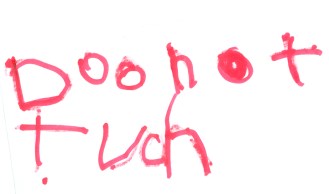
A delightful email from a new Souns champion reflecting on, “be lovingly too busy!”
donottouch
As we are getting to know each other, I should warn you I am not only random but also slightly (!!!) obsessive and controlling.  You have been warned.  🙂  My parents were VERY strict and I am trying to be a different kind of parent and adult than I was programmed to be.  I turned 40 this year and decided it’s time to be myself.  Not a moment too soon.  For example, it took me years to not “re-decorate” the Christmas tree after the kids would decorate it and go to bed so it would be symmetrical.  So I could enjoy it.  I very slowly realized that was NOT a good thing for my kids self-esteem.  So you and I are meeting while I am in the middle of evolving into who I want to be, not who I feel I should be.
 
I am reading the Souns book, and thinking to myself, “I hope Brenda will be patient with me.” I can’t remember a time when my children have been doing anything where I haven’t helped or corrected or guided them.  I am going to be reminded to not “help” or correct.  It is so ingrained in me that I don’t even realize I am doing it until it comes out of my mouth. I was reading page 48 and it says to be “lovingly too busy” to spell a word so they do it themselves, and I nearly had a panic attack in my head.  I hope I’m not a lost cause!  This is a completely different way of thinking for me, to let them struggle through something.  I completely see the value in this way of thinking, I’m just hoping you will be patient as I will probably need to be reminded…
 
And I continue reading…. 🙂

Unknown's avatar

Early Literacy? YES! I Smile!

Take the time to see what four minutes of building early literacy looks like.

Do we have the patience to watch learning happen in child time? Probably not…but this is a happy 4-year-old doing what she wants to do…no “school” and no one telling her to do the work of learning. Play / real learning looks just like this. Souns is so different than other early literacy programs. Souns is designed for how children learn best – through exploration, manipulation, PLAY!


Mexico has never been analyzed so closely –  so much fun!

tessamexico

This same child was already sounding out phonetic words. Deep learning keeps on going as long as exploration and manipulation are involved. Child time is SO important. She demonstrates years of accumulated hands-on fun with Souns. NO “SCHOOL!’