Unknown's avatar

From The Field In South Africa

DSC_0578

An email from a Peace Corps volunteer in South Africa. These humanitarian minded people are leading us into tomorrow. I am so honored to be working with them in this Rotary /Peace Corps collaborative literacy project.

Hello Brenda,

 
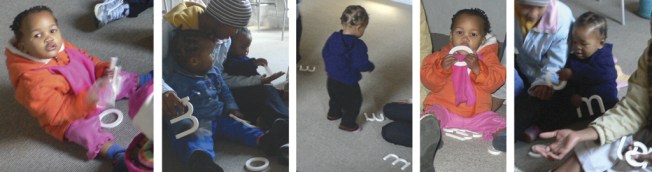
I have started the Souns programme with our village children.  Right now I’m focusing on the three-four year old classroom, and about 40 children have started the programme.  They are brilliant children!  I expected it to take a few sessions for them to really understand what I was doing, and to start relating sounds to the letters, but within the first 15 minute session, the children were starting to associate “ah” with the o’s and “mm” with the m’s.  It’s really encouraging, and the staff members are excited about the programme.  Considering the language barrier (the children can greet in English, but that’s it), I’m amazed at how easily the children are adapting to Souns.  I speak entirely in English, and hardly anything has been translated into Xitsonga after the first lesson or two.
 
Hope all is well with you!
Unknown's avatar

Through The Hearts Of Teachers

photo-199 copy 3

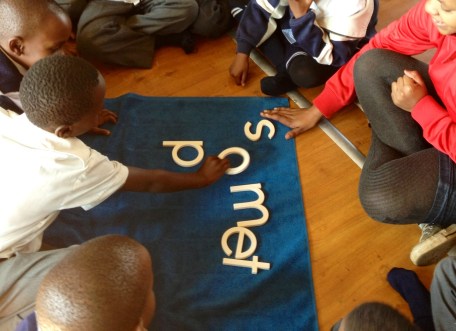
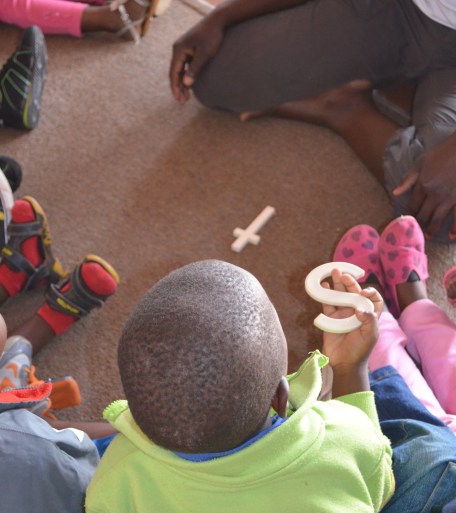
Teaching the teacher (parent or caregiver) about Souns initially takes about two hours.   The Souns program – focusing only on letter-sound associations – is the most natural, developmentally appropriate route to reading for the young child. Teachers love this simple, logical, effective tool. After the introduction of the program, we observe the teacher teaching the children (below).

photo-199 copy 7

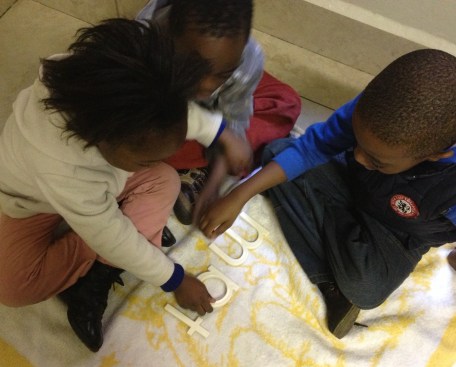
The result, often in three to four months of learning letter-sound associations, is the building of words (below). This “writing” by listening to sounds in words lasts for several weeks or a month. Taking the puzzle of a spoken word apart, building it with symbols is fun! This understanding of the structure of words leads to a seamless step into sounding out printed phonetic words.

photo-199 copy 4

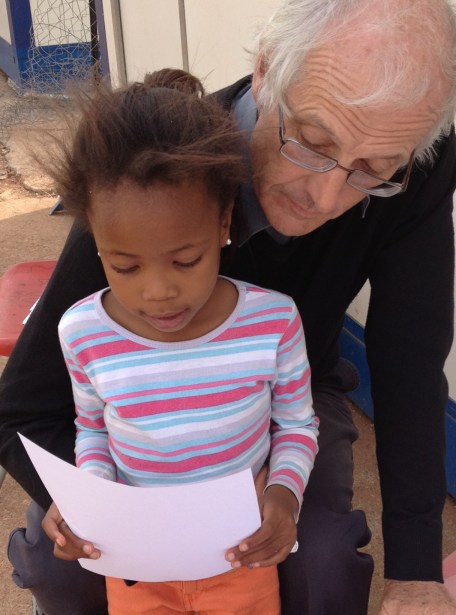
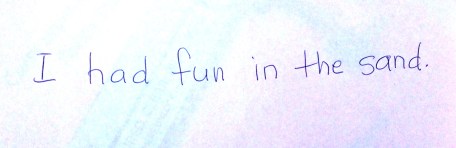
Soon, the magic of decoding – sounding out words – appears spontaneously in the classroom….one little person at a time. The five-year-old in the image below is reading a sentence I wrote. She sought us out to share something she had read in the classroom. I wanted fresh material for her, so I created a short phonetic sentence, which she read with no hesitation.

photo-199 copy 2

photo-199 copy 6

Are we making a difference in South Africa? Absolutely! Rotarian volunteers teach the teachers in the implementation of a program that is provided by a Rotary Global Grant.  In a country with 11 official languages, Souns focuses ONLY on letter-sounds, most of which are the same across all the languages. Letter-sound associations are the most direct link to writing and reading. These children will walk a better path toward success in school; they will read!

“Thank you!” to The Rotary Foundation for your support of this Global Grant 25244 literacy project initiated by the Rotary Club of Pretoria East in Rotary District 9400 and the Rotary Club of Peachtree City in Rotary District 6900.

Unknown's avatar

Compelling Success In South Africa

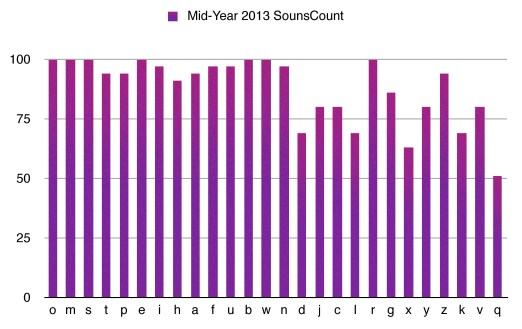
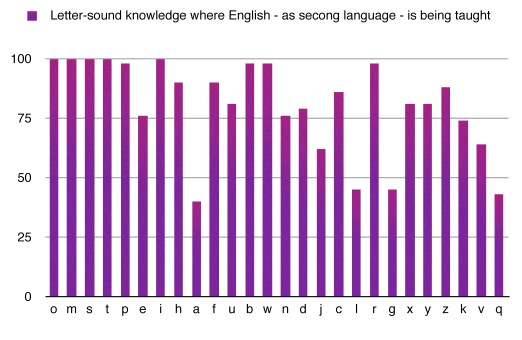
SounsCount: Mid-year assessments for two Grade R classrooms: One where learners are taught in home-language (N=35) and one (N=42) where they are taught in second language.

graphimageshollo5-13

The  5 year old children from these two Grade R classrooms in the township of Mamelodi* began their work with Souns in January 2013, several weeks after the beginning of their school year. These assessments were administered in late May 2013. Considering school holidays and only a portion of their year completed, the results (percents) are stunning. According to the teachers and our observation, building words and sounding out words – the application of letter-sound knowledge –  are regular activities in the classroom. When the school year ends in December, the learners will be well on their way to a successful school year in Grade 1.

While each classroom is demonstrating notable success, there is a distinct difference between the class which is teaching children in their home language (above) and the class where children are being taught English (below), a second language for the learners. It will be interesting to see the results as the children in the two classrooms continue through the Souns program.

LukiNelmapius5-13

Based on the joy we witnessed in the classrooms, these children are learning the fundamental skills of writing and reading – letter-sound associations – with fun and exploration. The teachers are engaged with the program and excited about the results. Souns® works!

This is a Rotary literacy project initiated by Rotary Districts 6900 and 9400. Thank you, Rotary Club of Pretoria East in RD9400 and Rotary Club of Peachtree City in RD6900. Children have a better path ahead because of you and the The Rotary Foundation.

*Mamelodi is a township of over a million population: http://www.mameloditrust.org.uk/photos/photo_about1.jpg

Unknown's avatar

The Power of “Working Alongside!”

photo-199

I am in a van on the road to Peace Corps Inservice Training (IST) in South Africa. Such beautiful hearts and minds sit with me. Grace, courtesy, warmth, and enthusiasm are constantly present in this organization’s efforts to better the world. I have been on this same trip to different sites on several occasions to train volunteers to implement our Souns for literacy program. I find it an equally positive experience each time.

PCV’s (Peace Corps Volunteers) have an energy and a flexibility that are bound to make a difference for their communities as their terms progress. One volunteer on this trip is doing what so many do, extending their term an additional year. PCV’s are making a difference and they feel it and often do not want to end the experience. The other side of the story, of course, is that the volunteers are learning more about themselves than can be measured on a calendar. The lessons will affect them for a lifetime. I think of it as tracking their future. Each of us has a gift already in place, but it is only discovered and confirmed through experience.

In the words of one PCV:

“Working alongside people who struggle to put food on the table, yet who have welcomed me into their lives and hearts has allowed me to see the great potential in the rural areas, and has motivated me to extend my service beyond the usual two years.  As I work to teach new skills, I am learning what it means to be part of a global community that transcends culture, ideologies, and language.”

Tomorrow I will be “tracking” my future, doing what I love most (next to doing a walk-about in my mind along a warm beach somewhere) – I will be introducing PCV’s to the Souns program. Those who find it compelling will be trained and will receive sets of Souns provided by The Rotary Foundation through a Global Grant project sponsored by RD9400 and RD6900. PCV’s are reaching thousands of children, making a difference one child, one village at a time. What a pleasure it is to be wrapped around with such purpose.

photo-199 copy

 And it was so much fun!

Unknown's avatar

Memories – the STUFF of our stories!

sounsworkkwatu2

khwattu13The door of the little museum shop at Khwa ttu was closed. The rippled glass pane in the antique double doors confirmed there were people inside. I turned the handle and the door opened to quiet conversations inside.
As if scripted, the lady behind the counter and I exchanged glances and time melted.…the look on her face mirrored mine. Oh, how good is that warm feeling of seeing someone you have so enjoyed in times past. Memories are real! They breathe life into those moments when we touch the past, paging through history to the sentence, the paragraph, the story.

Wrapping each other in hugs and smiles, we revisited the little class of preschoolers at Khwa ttu, of which her child was one. Four years earlier I wandered into the facility intrigued by the call of the billboard on the highway – San Cultural and Educational Center.  The story of man, specifically the bushman of South Africa, was compelling.

Khwa ttu was the beginning! A little class of children two to three years old and their hopeful moms was such a treat. The tiny facility, the little shaded play area, the magnificent view of the Atlantic, the willing minds and eager hearts imprinted my world forever. Visit after visit I came to train or teach, as they wanted. Then, the government closed the bit of heaven. Reasons are of little importance. I had lost my heart.

Nonetheless, each trip to South Africa I made my way up the long entry road to Khwa ttu in hopes of seeing the children, hearing the laughter behind the two neatly aligned stick windbreaks. I would ask for the families I had gotten to know. Fewer and fewer of them were at the center.  Finally there were none left that I knew.

But still I returned, hoping for an encounter with the past. This time the past was there to meet me, confirming that the time given in that little class had made a difference for a family and their child. The child is 7 now and loves to read. That is the gift.

Memories are powerful, especially when they meet head on with the present. They are the stuff of our stories…our lives!

sounsworksafrica3

Unknown's avatar

Happiness Looks Like This

smilingteacher

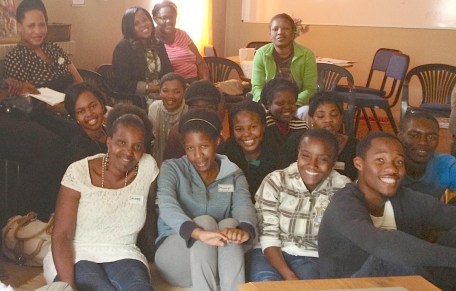
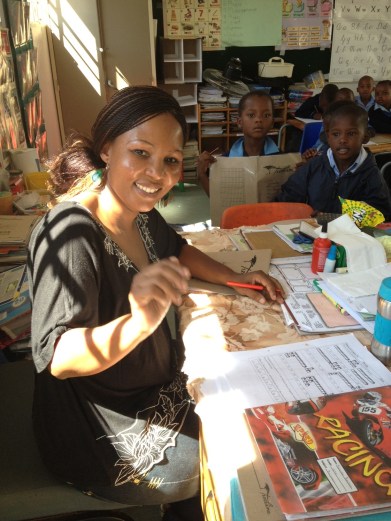
What happens to the heart when it is too filled with joy to fit in its body? It spreads like the sun all over the face. We have had over a week encountering such smiles. They arrive at the training sessions on foot and/or via crowded taxi vans – teachers and caregivers eager to learn new tools to help their children on the journey to reading.

The Rotary Global Grant 25244 was to impact 4000 children. The project is in its third year and because of community action – including the University of Pretoria and the US Peace Corps – the number of children being reached has doubled.

Rotarians from the international club typically join Rotarians from the host club at least twice each year to train new teachers or follow-up on previously trained teachers in the project. Often visits focus on classrooms. This visit focused on teacher experience with Souns. What has been happening? How is the program working? What are the difficulties? What are the great moments? Teachers are the greatest champions for their children.  I love to listen…it is magic!  For example:

One teacher shared that she greets each child as he or she arrives at school with a Souns symbol. The learner keeps the symbol until all the children have arrived. The teacher then collects the symbols by asking for /s/ or /m/ or /p/. This takes so little time and is a daily review of the letter-sound associations being learned in the classroom at that time. That activity excited many, who want to implement it in their classrooms. There were SO many wonderful ideas shared, each relished like a gift.

There were discussions about how to meld the Souns program with the CAPS curriculum for language/literacy in South Africa. Some excellent ideas were shared and demonstrated.

Getting teachers together on a regular basis to share their questions and successes builds a repertoire of good practice with Souns. It is quite beneficial for everyone….and it is FUN!

Look at the smiles!

happyteachers

Unknown's avatar

Alongside Their Children

hartenbostownship4-2011A Peace Corps volunteer sent this report from one of the most challenged provinces in South Africa. She was instrumental in this literacy initiative during her assignment and is currently proposing a plan to sustain the work after she completes her stay. PCV’s are life changing forces in their communities. I am in awe of their passion for service and commitment to humanity.

A family outreach program began in our informal settlement. Tribal leaders nominated residents to serve as “Community Development Coaches.” These Coaches were trained on key topics in early childhood development, play, nutrition, and gardening. Each Coach works with ten families for two years at a time, conducting weekly home visits and teaching both parents and children together. The program targets children ages 1-5 years whose caregivers do not have a source of income (excepting social grants). In 2011, toys and books were donated to each of the families in the program. The arrival of the books prompted the Coaches to request training in literacy. In November 2012, nine Coaches were trained on the SOUNS method and began to implement SOUNS with 110 children in the program.

            Most of the children were immediately delighted with the SOUNS symbols. They readily mimicked the Coaches and eagerly handled the O-M-S-T as each sound was presented. Even the children’s caregivers were excited to participate. Many of these caregivers are illiterate, and SOUNS provides an opportunity for them to learn basic literacy skills alongside their children. At one home visit, the grandmother in charge of four young girls sat to the side, pronouncing each sound carefully and showing her granddaughters how to feel the symbol. X (pronounced “sh” in Tsonga) is already a favorite among the children who giggle every time they shush their Coach. By using the SOUNS method, the Coaches expect to prepare these children to enter Grade R on par with their peers who have attended crèche. 

Unknown's avatar

It Is Happening!

“The baby is watching them dance!” is English translation of the last sentence child reads.

One step at a time. These children had Souns in their Grade R (kindergarten) classroom last year. This mid year of Grade 1. They are well ahead of their classmates who did not have the Souns program. One child at a time – one gentle, encouraging step at a time – we will build readers in South Africa. Thank you, Rotary! You are making a difference.

Unknown's avatar

The Magic Is In The Play!

Slowly! Step By Gentle Step, It Happens!

By arrangement with the teacher, this was the first time this child had sounded out words. Clearly he was ripe with readiness and was SO happy with himself. “Look at you! You are reading!”

He had Souns since he began school. This was mid-year.  He was almost 5 years old. The happiness you see is the result of a very good teacher implementing Souns in just the right way – slowly and playfully.

First the child learned 12-15 specific letter-sound associations, then he began building words (as you see) by listening to the word to find the sounds. He has been building words for a while, long enough to be ready for the next step….. listening to the sounds to find the word. Encoding – writing – comes before decoding – reading – in Souns.

The magic is in  p l a y !

Unknown's avatar

Souns With Remedial Group in SA

sounsremedialsa13-3detail

Thanks for your marvellous mail. The project is slowly developing
legs. Regards, Rotarian from Rotary Club Pretoria East

Hi [R and E],

I used SOUNS exclusively for a month in this remedial class of 10 students of 4th graders plus one 6th grader. Most of them have failed a couple of grades but I don’t know exactly what their ages are. They were suspected of being special ed students (I am a retired special ed teacher), but I think 
only one of them actually might have real processing difficulties. She still 
confuses the b, d, p, etc. and other sounds at times. Almost all of the 
students confused especially these three letter sounds at the beginning, 
with a mix of a few other letter sounds, but now do not confuse any of them.
 The word writing really took off when the diagraphs were introduced. If SOUNS was to be used for older, remedial students across Africa, my wish
 would be to have several sets of the letters available in a 
classroom, with a large table. That way they could write [words] and write to their 
heart’s content without waiting for someone else to finish using a letter.
 They could even write short sentences. I know several sets isn’t a practical 
possibility, but they love writing with those letters, and even 
watching other students write with them.

Thanks again,


[Special Ed Teacher]

handsandsitIRCsmall

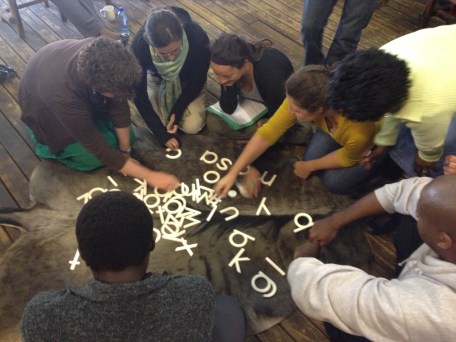
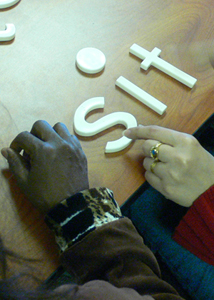
NOTE: What is described in this learning situation is exactly what our Interact Club does when working with the International Rescue Committee (IRC) in Georgia, USA: there is a large table around which the refugees sit and build words with the letters by listening to sounds in the names of things like fruit and vegetables, etc. Spelling is not the focus, letter-sound associations are key to early writing…whatever the age. They love helping one another build words, giggling at their successes. It is really beautiful to see.